Late Note: I realized when consulting this essay in depth that it was not the lost essay on time.
This essay was written somewhere round November 23rd of 2005. It had extensive edits and images I must carefully upload. The fact that it was "lost" made it significant. It is quite possible that now that it has been found it can be completely dismissed as irrelevant.
It's file name was "But what to call it." Though I always referred to it as "My essay on time."
It's strongest point was a reflection on time as a passage of light through windows: the framing of the modern technological computer predicament.
This is the sending of the message of images. What images of today -I get to the screen and panic, everything draws a blank. I both can and cannot see anything else there is to do. The Arcades of an insurance agency, perhaps, but the writing can only be a supplement in part to the boredom of employment – in the bloodless underworld of paperwork and bureaucracy – Hades, sightless and unseen, and Arcades:
“More Light” (but is there any thought?)
"Diese Niederschrift, die von den pariser Passagen handelt, ist unter freiem Himmel begonnen worden wolkenloser Bläue, die überm Laube sich wölbte und doch von den Millionen von Blättern, in denen die frische Brise des Fleisses, der Schwerfällige Atem des Forschers, der Sturm des jungen Eifers und das träge Lüftchen der Neugier rauschten, mit vielhundertjährigem Staube bedeckt worden. Denn der gemalte Sommerhimmel, der aus Arkaden in den Arbeitssaal der pariser Nationalbibliothek hinuntersieht, hat seine träumerische, lichtlose Decke über ihr ausgebreitet." [Walter Benjamin, Passagenwerk, v.1, 571]
What we begin with is not the arcade, but the trace, and the ruin. In fact these cannot be at all the arcades. It is not a Benjamin essay, though there is nothing wrong with that. However like Benjamin there is a play between images and text – and it is the interpretation, which is the tain between images –the last trace of that funny old man (Darger or Benjamin, or Walser or Jung…. Though too much has been made of Jung and he must be let to rest – he wasn’t a poor insane bastard like all the rest – well maybe he was). Its all about the shimmering patterns of images – and who tells the best tale assembling and dissembling the images (Claude Levi-Strauss’s bricolage, which is “assemblage” but cut and paste of collage, informal, Peter Berger’s vision of the bulletin board) – Proteus – old man of the sea… The old man himself is self-effacing, there is a wonder if he is even self-aware… as James Joyce never alludes to his own existence as narrator notated in the introduction to the corrected edition of Ulysses, so we will leave the book plate in the place of the old man of the sea, the one who wrestles with Telemachos in Homer’s epic:
(I actually like this version of the cover best!)
If there are cinders, not the arcades we longed for, but the cinders, the wreckage of the hymen of desire…
(http://www.othervoices.org/gpeaker/Passagenwerk.html ):
(“Fors une trace” – Derrida, The Post-Card)
"These writings, which deal with the parisian arcades, were begun under a clear sky of cloudless blue that curved over the arcade; even so they are covered with a dust hundreds of years old by the millions of pages in which the fresh wind of diligence, the heavy breath of the scholar, the storm of young zeal and the slow gentle breeze of curiosity rustled. For the painted summer sky, which looks down from the arcades to the study of the parisian Bibliotheque Nationale, has spread its dreamy, lightless cover over them.” –Walter Benjamin
I have visited the arcades, but they bore the strange resemblance toward being a bomb shelter. I bought some entertaining music there, mostly “world music” at the time. Now we don’t have the arcades like this here and I don’t have a French woman (or the interest to be with a French woman) to travel there again with. I am sick of French people and the insurance agencies they seem to coerce me to work in to defend myself from their hard fucking lawyers:
(Versicherung Agentur)
(Welcome to your new home, now leave)
“Then someone says you’re in the wrong place my friend
You’d better leave!” (Dylan – “Desolation Row”)
I actually like the insurance agency. Its essential homelessness is more profoundly at home, and like this document, I have time to actually decorate the walls of boredom with post-cards. These are the studded accents of the scintilla (c.f. the same passage of Jung with reference to Saint Christopher)
http://www.ilsentierodineriflavi.it/sculture/pag_11.htm
(I don’t know why this was called scintilla, but it is fascinating)
(The Pleiades)
We go to the arcades to make a selection – and principally because it is a form of bourgeois bricolage – however herein lies the deficit – first that capitalist production is fundamentally ungelassen. However Benjamin was a fairly adept critic of the arcades as a merely bourgeois phenomenon – there is a kind of idealist principle at work here as well – the verging on the fringe of the debacle of the Second World War – otherwise all would be well – the internet light spills through the walls and ceiling of the arcades, with a pleroma of images. The arcades were loved in the beginning of the 20th Century as the internet is loved in the beginning of the 21st Century – but the illusion has to do with the quality of light spilling through.
Arcades – a series of Arches: and the Arc – a spanning of distances, “bound volumes” (Hachamovitch) always a twist of bondage, a twist of smut (but what does one expect from helpless and hellbound phenomenologists a la Lingis) – we will have to get into that later. The bound of a leap and the distance toward which one is bound, as if a project could “venture” some sustenance…
The Arch may also be the arché and possibly even the archetype—after all Jung should be interpreted as well, but gingerly, lest the essentialists slip in again with some sense of absented wholeness – the arch is parabolic in these efforts – something seems more appealing in the radical of two – perhaps a dimensional leap, not just the age of the sphere or the anthropos rotundus – still the trace of originary inflation – if we could only see through all this distaste to the essence of the womb like arcades, yoni….
But the essence of the feminine is separation and farewell….
Köln Dom
An der kürzen Brief zum langen Abschied (Peter Handke). Jung actually uses this term in his passage of Symbols of Transformation speaking about the vagina as “sheath” or watershed – abschied is farewell.
Does the curve resemble an upward opposition to Lucretius’s assertion that atoms must swerve in their endless plummet through the void?
Norman Spinrad, for instance,
Indeed, Norman Spinrad wove a tale of the Void Captain – a title that colleagues may condign as bordering on the obscene… But the void is infinite separation – there at the end of the tale the captain is suspended in his eternal nuptial flight with the queen bee – his soul pilot (even Sting – and to Rosenzweig – “death’s sting” mentioned in Star of Redemption)
Condign, I like that word though I do not know what it means? “Kindly?” -Today I saw a man crossing the same bridge twice. We passed each other going in opposite directions both to and from the “Golden Shore” annex, and I shouted out on the second crossing, the second meeting, “bridge over the river Styx!”
And what to say?
Well, we’ll never know, “To say it was an essence,” a hidden formula, a concatenation of images.
I warned the madman that he needed to keep his feet ready to dance – ready to dance with the images – because the images will get you and take you, and, well, what else is there to say?
I write to this image, this looming immanence – a red planet, a great red eyeball, hovering over the luminous shores of luna – and luna is hardly a place to call home… and what did they do in terran gravity? Learn to become weak and thin? When even the press of one’s arms upon a table top – so firm and re-assuring – could launch one off into assails of delight….
Now they tell me that my dissertation dashes are less than exemplary. They say that a dash is supposed to look like this—and I feel somewhat incompetent with the whole thing – but it actually seems to work at least in this format of Microsoft word (automatically capitalized for your predilection, pretension, and recollection, like the name Leight:
L-E-I-G-H-T) How I would truly love to inundate the man with light – engulf the demon in the angel of his namesake – Michael, the warrior, yeah, well, there are other warriors under other names and names are older and twist far into the wilderness…
Justin – Justice…
Maybe it will work – and maybe there is no precedent.
Maybe I should just shut up and let everybody run me.
I am tired.
Meanwhile Balthasar of the aliens has driven a perfect plan.
Right now I am tired.
Old women speak to me, they speak of credit cards and plans for my final judgment. They have been so betrayed by the world, like Corinne they have been so betrayed by the world. …And what of it? They pray that their god is a just god – that he really is a just god – and that a sense of vengeance and punishment of those delinquent is absolute and everlastingly final – complete. And now for other things.
“Don’t you put your eyes on me!” One woman cried… the faces of the obscene and the insane – once again eagles from Space 1999:
But here allow me to contain and continue – this horror is at one and the same time the manna of the self. But what to call it?
I will need to prove to you in images the steed, the steady scream of the yes,
Similar in fact to Event horizon in it’s horror:
These are just the guardians at the entrance – these are just the masters of the horror at the entrance… VAJRAPANI – the wrathful, cutting diamond edge of water: …and you can drown in it – you can drown in this one…
Fierce guardian on the side of light: will you step through?
Balor’s paintings – bloody precedents. But Balor presents the mythology of attachment to life. You hold onto life – give the gift of immortality and you are rendered with pandemonium – terror. Witness then Event Horizon as an effort or glimpse of immortality:
Liberate Vos Ex Inferis
Save yourselves from hell:
But what to do then with this misconception?
Crucified on the void, the image of the cross, balanced and broadened – set on its side.
I loved these images as though they might preface some deeper understanding of the self. I thought about them yesterday as I exited my car into the night. Das Unheimlich.
Images of aggression and terror – not the bliss of Greenaway’s Prospero’s Books – but that is truly another story, a more peaceful one at that. These are images of pandaemonium. I have been wondering about the penetration – the literal penetration of the physical body – once even our physical existence could be taken for granted, regardless of setting – ah the tabernacle of immortality…Zardoz at the end of the story, many of the immortals gladly welcome death as a release from the horror of living infinitely in the prison of their own existence (I believe the people doing the killing are called aptly enough “exterminators”):
(Everybody dies in the end)
(Martin’s vision of Pandemonium).
Everything seems fairly well ordered in Pandaemonium. Lucifer in subsequent images resides over a senate – not a great deal of terror really going on here… more like a Mussolini or a Nazi work of art – big fascist stadia ala Albert Speer:
(Speer’s Zeppelin Field)
This is about the evil (even “evil” seems a moralistic denial of the depths of grief) of totality – of absolute rule given the condition of Lucifer’s (bearing “false light”) rebellion from God – its all way too complicated for me. Lucifer won’t bow down to human beings, whom he regards as apes – pure animals. However we have gone from the horror of insight into the light – even the black hole light in Event Horizon – to a kind of darkening of the technological mind, wedded to the conception of light – its conception of light as an instrument of brutality.
(Blowing the top off of everything)
False light, most alarming. Here also the arch of the arcades is problematized. There apparently is no more arch – just Ionic columns of light. Is the arch (arc/bow/arc en ciel/rainbow) so important? If there is no more of a Lucretian “Swerve” does the universe come to rest in its eternal plummet and ascent? The horizontal axis allows for the horizon, the plane of everyday life – which Heidegger calls forgetfulness – but could this everyday life some how be the most simple humble thing if it does not loose sight of the vertical axis of life/death the gods in the heaven and mortals on earth. To live blind on the horizon is as dangerous as it is to live in the vertical axis of the world (axis mundi).
(The crash of the Hindenberg, Led Zeppelin 1)
The Zeppelin exists on Speer’s zeppelin field. The zeppelin is a symbol of inflation – hydrogen of the sun – highly combustible – anthropos rotundus (Edinger has a fruitful discussion of elemental inflation in Ego and Archetype) – the claims of a baleful superman with a weak emaciated ego structure (Reference Jung, I think Structure and Dynamics of the Psyche, cross reference a passage on St. Christopher). Strange to think that the screaming electric guitar of Zeppelin, hallucinogenic induced high fantasy should be reduced to the pittance of fascist inflation. Zeppelin themselves chose this bloody fantasy – maybe for the element of catastrophe – not in the inflation itself, but in the process and cycle of deflation, radical expulsion of gas by fire, consumption in a crumbled mass sinking to coagulate with the earth. The title is said to be attributed to the rock group on the basis that someone felt it might “go over” like a lead balloon
(Schuler’s “Crystal Cathedral”:
Strip mall architecture applied to late consumer capitalist Christianism)
I can’t be certain but Schuler’s Crystal Cathedral seems a bit less pernicious – though it is a kind of mall-technology… the Western United States version of the “Arcades” a la “The Beverly Center,” “West-side Pavillion” or “Santa Monica Mall.” All of these use light and capitalist consumption (in Schuler’s case of religious sentiment). It is all much too banal, but then again evil (at least as a kind of denial of the depth of grief) is banal. Nevertheless the element of lockstep conservative christianism in the United States becomes a source of conformity and regulation of human desire and belief. Church becomes inquisition – the transparency of the cathedral permits infinite surveillance of the panopticon:
(Those crazy masons)
The issue of the vertical axis: One train of thought leads me once again to Thomas Bernhard’s Concrete, where introversion leads to suicide, and extroversion leads to homicide… constituting the infernal version of the vertical axis – but the binding comments that it is the lateral escape (not unlike the crab – which Harvey Rabbin used as a metaphor to describe Derrida’s deconstructive method)
Sentimentality and brutality – indeed. Light. Light, but in the meantime the horror continues:
Henry Darger saw in terms of the endless dilemma of war, conflict and struggle, which beset the Vivian Girls and their nation through to the final ends of his life: The offense continues, “meanwhile the offense continues.” (And Derek Mahon iterates it in Matthew V 29-30): “But the offense continued.”
A bloody heart and a good book. Darger offers us something superior here in his vision of weird feminine magnificence and beauty. Weird beauty is something else.
The boys remain playing in their purple and gold uniforms with their machine guns. The girls, or their semblance (regardless of genital configuration, which for Darger seemed largely gratuitous or vague…
Perhaps Darger offers a way or a means back and forth between the horror of death, disembowelment and evisceration and the joyful, sensual enjoyment of the child – the full palate garden of color of the little girl. The oppositions are stark – and in this sense more meaningful than the “Balor” paintings represented in 1999 – Darger goes into the darkness and back in a continual tormented swing of the images.
On the lighter side of things there is the Buddha – but this is a precarious catch of the imagination…. “Make of yourself a ring to catch the hook of the Buddha’s light.
Three heads and eight arms may be yesterday's time. The eight- or
sixteen-foot body may be today's time. Yet yesterday and today are both in
the moment when you directly enter the mountains and see thousands and
myriads of peaks. Yesterday's time and today's time do not go away.
Three heads and eight arms move forward as your time-being. It looks as
if they are far away, but they are here and now. The eight- or sixteen-foot
body moves forward as your time-being. It looks as if it is nearby, but it
is exactly here. Thus, a pine tree is time, bamboo is time. (Dogen)
Thursday, October 9, 2008


Wednesday, September 10, 2008
Hatted European Men
Of recent Oppermann has picked up on the Hat waving content. I thought this radically important, since I saw them all waving their hats, somewhat like mischivious boys shouting "Hurrah for Karamazov!" Without any further ado I will include the hatted european men I could find.
Particular attention is paid to those who are wearing straw hats, because they are better for waving.
 Vincent Van Gogh (Beatific) wearing a Straw Hat.
  Was Freud (wearing hat) a Glandolinean? (Einstein stated that when he tried to correspond with Freud that Freud was overly concerned with his own theories. Am I overly concerned with my own theories? Is it a matter of crippling introversion to be dazzled and puzzled by the world within, a stranger to oneself?
 Robert Walser a bit dashing with his Hat. (No problem here.)
 Adolf Wolfli (looking a bit like a prophet) with hat and strange boyish britches with bulges at the knees.
 Carl Jung With Hat. (Another swiss witch doctor. His "water works" may have been near this spot, and he was a very very lucky one indeed!)
 Robert Musil with Hat. (This soft but square hat qualifies as sufficiently straw-like and soften's the man's struggle with Viennese suffocation.)
Thursday, August 14, 2008
The Maker of Words: the toughening

I once was a maker of words, now a maker of sentences. Oh, forgive me, I know this thought is leading to nowhere already. Why embark on any such thing at all? I am tired. I am already tired and yet I have hardly already begun. What was I saying? Did you forget what I had said already? And yes we can turn round and simply look behind us at what was there behind us: there all that beauty, and now what is ahead of us? Is there an empty window of darkness? a single pupil of the eye which symbolizes the receptivity of the soul right here, yes, right here in the body: don't look him in the eye, don't look evil in the eye and find out it is you looking back at you: Isn't that the lesson from the Lord of the Rings? (JRR Tolkein, some kind of timid, and yet investigative bastard...)
Here we are, writing a story for nothing, and for no-one, sounds like Samuel Beckett: or maybe it's our other friend Henry Darger? Maybe it is Adolf Wolfli or there, Robert Walser: there all of them the gang, with their hats out waving, their straw hats: or Vincent Van Gogh or maybe it's Robert Musil... Or maybe it's even Carl Jung: he's out there in some pictures with a straw-like hat: they are all waving their hats, these insane old European men with their best intentions: as if waving us on to some kind of future woven out of the threads of so many genetic fibers, woven from a thousand generations in a given land: we can say that the land has changed the people: this much is an ethnic fact: north to south, east to west: we are all becoming different: and the people are living here and we are all getting used to a specific kind of weather.
So far we all say good day to each other and we ask each other about the weather: but we never knew how bad we'd feel if we didn't really fully agree with the weather: here we are, most of us transplanted in Los Angeles for just a generation or two: that's all really, just a few instances of time where we could speak of the ullulation of the species through the reproductive act. So far we're all just putting up with the weather but nobody knows really who we are, admitting we are really just putting on and up with an act.
Words for the maker of words: that's all of them, these words are my only children, and you can shut them up in a jar or a desk drawer, or now on the back of a hard-drive somewhere whose very location one day will be forgotten. You can make and send forth a man, yes, you can embark on that myth: or you can live into your truest belief: that while the attempt to send forth one's seed ends only in chaos: the attempt to send forth kindness has some effect of leaving the entire system a little more kind, a little less selfish.
What I am saying, I admit, is a matter of conjecture, because I am only telling it to you now, and you cannot believe a man's kindness for what he says, only for what he does. Watch ever for what Men and women do, not for what they say. (What good are words then? -Some words are kinder, and tend to lead us into more imaginative spheres, while other words tend to hold us back: possibly even to retard or abuse: for there are some people who have turned their voice into an instrument of fear, of prompting rebukes and controversy, suggesting the most horrid thoughts, screaming into the delicate ears of young children:
Abiennia, the land of the Abbess
Glandolinia, the land of the Glandular Reflex.
Could it be that Henry Darger saw the eye of evil in his instinctual, glandular response? Perhaps but this renders for us a purely reductive bio-physiological response: the Glandolinians: like Sigmund Freud himself: interested in the glands of the Human Body (but this time in the guize of a charlatan-doctor, the hallmark of 19th Century thought, the medicine side-show): the idea behind psychotropic medicine is that mood could be controlled by modifying the chemical balance or imbalance of the brain. Glandolineans! But they could not not get the best of Abiennia: a-bien-nia. Bien, meaning fine and good. But also the way in which the syllables tripple round each other, like three, six, nine, sisters: Vivian sisters, to be certain, came trippling round the corner of the parapet of their little castle with clouds: the keep in the distance: because Henry Darger's work is about loss: it is about the loss of so many thousands and millions of men: the loss in a great battle, many sacrifices in such a great war: and Darger accepts all these sacrifices, nobly, as he commands his men: but this fight, this sacrifice, this sadness: to show that the Glandolinians will not win, but nor will the Abbienians! Isn't that the result for kind folk on this side of the dialectic of violence: in our version we get to win because we and the evil forces get to survive. In the darker version there is victory, to be certain, a certain kind of cleansing or purgation of what is unclean: and this ultimate act of hygiene has the effect of being a genocide of what we choose to forget when we live too much a clean and gentile life: and fail to realize that there is suffering going on all round us. That is what is truly appalling. There is so much suffering, and we are only barely, barely able to effect a single moment of that suffering. It is enough to drive some God-fearing men back to their home countries, back to the womb of their evolution: as if the dance of externalizing and conquest had somehow been stuck out here, way out in the wild west: where we attempted to conquer savages (thinking of course of "Dead Man" as the North Pacific version of this, and "Fitzcarraldo" as the Amazonian version): somewhere in this we realize that we are the savages: we turn around in dread and go back to our ruminations in the states where, somewhere we feel someone has given us birth.
It's horrible, horrible, yes. It is laughable and it is horrible. This is a kind of predicament, really for thought itself in the United States after the issue of colonization has come home to roost, and all the best intentioned ideas founder on the rocks of poverty and ignorance. Well, what did you ask for? Success? Victory? You asked for a certain kind of failure. Yes, it was a certain kind of most tender failure. You asked to be able to keep asking your questions until you had asked no more, till your very light had gone out: and the people would look around after you, asking: had he really meant this??? No-he has meant nothing at all, he has tried in vain, an emptiness, a nihilist, a man without qualities, a man without children.
And so I am a man without children. I think of them now, every day. I think to myself that I will not have any children to hold me back from my work, that I will continue to labor and toil, endlessly for a disease that knows no limit in the heart of human beings. What do I do here?
There are those who want to live forever. What about death and dying? Can it be so hard to face the consequence of a life where one has been given only to writing and to speculation? That one has given their life-time to speculation: to make that the only seeming child. I see the selfish gene in so many men, replicating and procreating, but what about simply stopping and breathing a sigh of grief concerning the labor of our continent? And what about overpopulation? (Now I am beginning to sound like an old saw, in great need of some kind of lubrication for all the wood-cutting i seem to do.) But just think on it, please, some of us will need to die to make way for the path of things to come ahead. Some of us go on to procreate madly: making children that seem born into an open fire: the children of the ghetto. And there are some of us who play at making love and never produce a single child. (Well, I have my writing, to be certain, and in this I retain a certain sort of dignity as a bachelor-machine, even when I pursue the course of being a married man).
You know I read this, and sometimes there are those who will read it after me. I can say that on my finger now is a band of yellow gold that I wear in an act of love that exceeds my ability to succeed or fail in what I do. Regardless of whether I am good enough, I still love, and this gives me a certain perspective concommitant or superior to Beckett, for example, as a similar bachelor machine. It is not fair to say this. I can't compare myself to any great authors, since it is an act of vanity and poor authorship if i compare myself to anyone great: Kleist or Hoffmansthall, Beckett or Seneca, Aristotle or Plotinus, Sartre or Heidegger, Jung or Freud. All of these intellectuals I seem to rather dutifully nod to and simply bow my head in their presence. What do I do? I write moments of connection about them, I do not exactly make them figures in my own plays, since I am not as obstinant a writer as to actually produce a play: like the story of Nietzsche in "The Second Book," Nietzsche is a figure in Muharem Bazdulj's book, not mine to be certain: I don't want to make him a "figure," I am overwhelmed and feel uncomfortable round him, just as one of my friends points out he will not speak yet on the matter of Goethe...
Rambling, wandering, oh yes, gamboling, and now I am afraid that I have outspoken and outstripped myself with my rambling just a little bit further: have you ever wondered what Loneliness James Joyce or what-his-name-Marcel Proust must have felt when they wrote such enormous tomes of themselves? I wish I had time to try to feel that much loneliness... but really I have to just plug on with my job and my life: I have to try to find a way to fend for a living and cover all the responsibilities of the position that I do. And I just barely cover them. Oh God, it seems I just barely cover the duties that I need to do.
Maybe one day I will become more adept, I will put down all anxiety and indecision, and I will make only decisive choices: maybe on that day I will become a kind and motivated man. In the meantime I will still struggle with my own delay, I will still be a conflicted man who likes to dawdle and to daydream, who wants to fall into fantasy, to fall off the edge, to float in some nebula of greatness for a moment, it is an error to be certain.
The way of the scribe is simply to report back what he does see. So I have attempted to write back to you, as a sort of maker of words, though I am a maker of nothing, since words were somehow given to me by the world: I can remember learning them one-by-one with an intense curiosity to know the workings of each one: to learn each implication, each tender insinuation of meaning. Of course I am indeed very far away from being a master of the English language, since any language itself is nothing unless it is constantly changing, adding, being reformed into some laughing lament of great grief.
A hard rain's a gonna fall. It'll be raining in all dimensions, not just one. It won't be any one kind of rain, it will be resoundingly hard rain, and we will have to learn to soften, just like mud, like the branches of a tree which with hold themselves from a river so that life can remain rooted in this spot, so that it does not have to all be washed backwards: back in evolution another billion years back into that salty, briney crotch of the ocean. But if the rain falls too profoundly, then become like the mud and silt, spread out, but yes, containing gold dust! Carry the ore of the mountains and deposit it in veins of life in the midst of the cold dead depth of the earth. There in that place where there has been no motion for a million or ten million years: pull forth the veins of sunlight and make a golden ring.
It is difficult to escape the mythology of the ring. The exit wound of the golden ring is one where one sits on the other side of heroism. Jung shoots Siegfried with the help of a savage in his dream: he wakes and needs to find some suitable interpretation for such an action lest he regard himself as Siegfried and shoot himself. I can say that I am moved to simply remain, and to heave a sigh where I do not know what exists in this particular space that is beyond the excellence, and perfection, the liberation that the Hero searches for. We can say that the hero searches in vain, but then what? It is not because the task is fruitless that one seeks to pursue it heroically: Christ says "my kingdom is not this kingdom;" and by this he acknowledges defeat. But this is the truest trajectory of the hero: no success like failure (and failure is no success at all). I am not here to advocate for a Christian point of view either, though Christ, I may say, figures large in Henry Darger's image of Abiennia Flag: Abbieannia. Christ, the official self-effacing hero. Thank God for Christ, I can say that. Siegfried must die, but Christ must not. Christ has already died, and according to the authorities (which makes this last statement exceptionally cheeky), "Christ has risen." But I cannot believe that this "Christ" has really risen till my neighbors and my brothers really can laugh and know in their hearts and souls that they can love again.
I said this once to a woman. I think that forever after she might hate me for it. I said that I really wished for a day when a child would wake up and from the moment they wake they would feel kindness, and they would grow and flourish, they would not be cursed. Maybe this kind of perspective is woefully one sided. Maybe such a comment provokes everyone who is in touch with the universe to give me a swift kick in the ass! But I tell you I love all this so much that I will try the best I can, and live and die by the thought that we do not have to be abused in order to grow: all this toughening: I will experience the toughening, this terrible toughening. When abuse comes into one's orbit, when one welcomes the abuse, takes it on, and plays with it, saying, I love you, I will be kind to you, no matter what you do, I will be kind to you. Oh how one wants to cry, once again! You could label me a "cry baby!" But then you would not be far from the mark. Some of my friends are tired and sad. Some of my friends are tired of talking. Some of my friends are somehow someone else: Hoffmann, Kleist, Nietzsche, Fichte, Darger, Web-Logs, Filth and Entertainment. Somehow all of this continues to move on.
I am so sorry, so sorry to embarrass myself in the future, so sorry to have said something that might compromise who I am or who I thought I should be, but I wanted to write just this instant a free writing, and to plunge from my heart into the depth of all I have been feeling: almost inexpressible: and therefore the delay between now and the last time I wrote a sentence like this. On top of this my best friend has left.
("You're gonna have to find yourself another best friend... Somehow" -Bob Dylan) (But Bob Dylan is not my friend, he is just some old strange fellow who is acquainted with despair, so I like him, I like the positivity he seeks in the midst of all his hard hard rain. It really is hard.)
Soft earth, mud to the sea, gold dust...
The cycle continues.
The cycle continues.
It is the development of the father, akin to the doctrine of the assumption of the Virgin Mary: flesh into heaven: that the hero no longer is the only hold of consciousness. We laugh and share a wry smile and say, "but enough of that, I still love you."
Sunday, June 15, 2008
Bestandsaufnahme from the Oppermannian Praxis
it is sunday. Oppermann does not use his computer on Sunday[.] This was a test to use my telephone which failed to a large degree. I have edited the web log. I took some intense pictures of trees in Oppermann's parking lot either that day or the day before. I have taken less photos since I came back from that visit.
Friday, June 13, 2008
Notations on Various Conditions
While ordering the beginning of the day I was forced to think on various topics while reading Deleuze and Guattari's "War Machine":
- Relationship does not belong to the order of the state: it is not observable. Relationship is always imperceptible, a form of magic outside of the surveillance of the state.
- Desire cannot be forced: desire cannot be regulated. This is the fundamental element where desire and relationship are not obtainable through the state apparatus.
- Deleuze and Guattari have yet to (and never will in this form) comprehend the relationship to the feminine, Isis and Asherah. There is something about their psychology that remains dry, spirited, but somehow unwilling to deal with all the anima attachments that tend to drag us backward--- it is too big a question for Deleuze and Guattari, and for Foucault, who tended to work on the issues of the shadows of relationship through power: they did not understand that the desire behind this is painfully part of the state organization itself: that the state is not uniformly counter to desire... even though they admitted to micro-fasciscular forms of power and organization... the argument was not developed enough. I do not want to call the missing element "the Feminine" because that definitely rings wrong in this instance. I can call it soul. They lack soul.
- http://en.wikipedia.org/wiki/Asherah
- Bob Dylan's "Isis" is about as close to a non-Oedipal description of desire. If it is Oedipal, then it is a matter of passing through Oedipus, not of being reducible to a psychoanalytic model by any stretch of the imagination.
- I am thinking of "Snow Crash" http://en.wikipedia.org/wiki/Snow_Crash by Neal Stephenson. Stephenson is rather blind when it comes to politics, but his theory is that the cult of Ashera spread a sort of venerial virus that blocked out thinking.
- Isis is associated with the development of the city state: at least as is discussed in Jung (who may be a psychologist of the state, but nevertheless is a heavy influence in terms of his capacity for developing relationship in the most profound sense between various conditions: incarcerated, small, captured and also large, kowledgeable, infinite and so on... and his use of dreams): Jung discusses the "Mural Crown" of Isis representing the city walls.
- The City walls represent order and regulation of flows (of desire, commerce, etc.): various means of police/polis. When a city is stormed by nomadic forces of desire it is said to be raped, violated as a woman is violated.
- The State apparatus sets in and defines and controls, orders and reifies only so long as there is soul.
- Love labors, "alienated labor" (Marx) ("Arbeit") represents the point where the demands of love reach a crisis: work ("Werga," "Werk") and desire, which are freely given turn restlessly at the point of becoming alienated from desire.
- I am working in a modality where I stand as a "man of state" with his letters and authority (It is the set up of "middle management"), and yet I understand that the interface is through relationship and connection. I bring my employees together: and yet desire cannot be forced. The employees are resistant to the idea of forced relating. The result is that the war machine slips out of my dominion....
Tuesday, June 10, 2008
Given The Circumstance
I am driving on my way to work. I am driving as I have been driving all these years. I am making minute travels across a sphere whose circumphrence I have never seen with my own eye, enclosed with gravity, I still seem to be driving across a plane. I am driving to work.
A similar voyage, be it the cooler blue alien fields of psychedelic hallucinogen colors produced in "2001 A Space Odyssey," or into the golden Rubedo of "The Fountain." The point of each journey is to reach the end of all stories, and stories about stories and achieve renewal through annihilation in an abundance of energy (the closest earthly equivalent would be putting oneself into an active volcano). The problem is that this event has been expressed from many different angles already to say the least.
But there are many many stories. And each story and the finest articulations of each story must be thought out, and thought through. This is where it apparently seems that the stories are endless, possibly a bad infinity of repetition: this is the definition of "Nausea" at it's worst: continual redundance that one is forced to live out over and over. One has enough "sense" to understand that one is forced to a cruel repetition.
The longest travel yet imagined is a 12-hundred light year journey as imagined in Arnofsky's "Fountain" (oh yes, we know that the universe is a lot larger, but we have not imagined this as a journey in any significant manner). We could say that it lasts only as many thoughts and stories take for it to get there, for what else to we really measure time by in the absolute sense, but the prevailance of certain images and the time it takes to digest them. What was the purpose of such a lengthy trip? Renewal and Annihilation? Easily stated, but hardly meant. It certainly was a significantly greater distance than my entire trip to and from my banal place of work (working as I am within a sphere or structure whose intent I am unable to perceive in any significant manner--- so I report on minutia of the day and call these reports "Bestandsaufnahmen" concerning films I have seen or particularly satisfying experiences of various colors and flavors of desire...
A similar voyage, be it the cooler blue alien fields of psychedelic hallucinogen colors produced in "2001 A Space Odyssey," or into the golden Rubedo of "The Fountain." The point of each journey is to reach the end of all stories, and stories about stories and achieve renewal through annihilation in an abundance of energy (the closest earthly equivalent would be putting oneself into an active volcano). The problem is that this event has been expressed from many different angles already to say the least.
But there are many many stories. And each story and the finest articulations of each story must be thought out, and thought through. This is where it apparently seems that the stories are endless, possibly a bad infinity of repetition: this is the definition of "Nausea" at it's worst: continual redundance that one is forced to live out over and over. One has enough "sense" to understand that one is forced to a cruel repetition.
The longest travel yet imagined is a 12-hundred light year journey as imagined in Arnofsky's "Fountain" (oh yes, we know that the universe is a lot larger, but we have not imagined this as a journey in any significant manner). We could say that it lasts only as many thoughts and stories take for it to get there, for what else to we really measure time by in the absolute sense, but the prevailance of certain images and the time it takes to digest them. What was the purpose of such a lengthy trip? Renewal and Annihilation? Easily stated, but hardly meant. It certainly was a significantly greater distance than my entire trip to and from my banal place of work (working as I am within a sphere or structure whose intent I am unable to perceive in any significant manner--- so I report on minutia of the day and call these reports "Bestandsaufnahmen" concerning films I have seen or particularly satisfying experiences of various colors and flavors of desire...
Monday, June 9, 2008
The Fountain, Metonymy and the Life of Images, The Pace of Film, I'm Not Mad
 " The Mercurial Fountain" (C.G. Jung, Psychology of the Transference)
We are the metals' first nature and only source
The highest tincture of the art is made through us
No fountain and no water has my like
I make both rich and poor both whole and sick
For healthful can I be and Poisonous
(From the Rosarium prints, the first of which is pictured above)
1.) The Fountain is an ancient image of an animated spring. The fountain exists as a place fundamentally relating to water, which seeks ever its own deepest depth, and thereby it is a matter of the soul that is reached through descent: but the fountain "wells" upwards.
2.) Metonymy is the process of the transfer of images, springing from one isolated context and being transfered to the next. The process of this springing produces as much energy as it takes for us to imagine the connection through the metaphorical/metonymic rift. The image of the fountain is profound and worth spending time with. The fountain springs. Pegasus (Greek, "Springer") springs (pegazei) with a leap of poetic imagination. And we unblock blocked springs, and dry wells, where we rested so long awaiting our images.
3.) The film by Darren Arnofsky entitled "The Fountain" lacks an essential element of pacing in order for it to be considered great. The pacing is frantic, consumer Hollywood pacing. Thus the film capitulates to capital, surrenders its poetic reverie to the manic pacing of the ...Conquistadors in Hollywood all too soon. The point is that the film is a wash if we consider it runs through its Conquistador element like some quick remake of an action film like "Raiders of the Lost Ark." It is a film about a real voyage, so it has to travel beyond the comfort of "adventure" into something much more uncanny.
4.) I may apologize for some of my previous posts, though as yet I will not remove them. I was so incredibly mad.
1.) Wel-2 from the dictionary of Indo-European roots:
To turn, roll; with derivatives referring to curved, enclosing objects.Derivatives include waltz, willow, wallow, revolve, valley, and helix. 1a. waltz, from Old High German walzan, to roll, waltz; b. welter, from Middle Low German or Middle Dutch welteren, to roll. Both a and b from Germanic *walt-. 2. whelk1, from Old English weoluc, weoloc, mollusk (having a spiral shell), whelk, from Germanic *weluka-. 3. Perhaps Germanic *wel-. willow, from Old English welig, willow (with flexible twigs).

4. Perhaps Germanic *welk-. walk, from Old English wealcan, to roll, toss, and wealcian, to muffle up. 5. O-grade form *wol-. a. well1, from Old English wiella, wælla, welle, a well (< “rolling or bubbling water,” “spring”); b. gaberdine, from Old High German walln, to roam; c. wallet, possibly from Old North French *walet, roll, knapsack. a–c all from Germanic *wall-. 6. Perhaps suffixed o-grade form *wol--. a. wale, from Old English walu, streak on the skin, weal, welt; b. Old High German *-walu, a roll, round stem, in compound *wurzwalu (see wrd-). Both a and b from Germanic *wal. 7. Extended form *welw-. a. wallow, from Old English wealwian, to roll (in mud), from Germanic *walwn; b. vault1, vault2, volt2, voluble, volume, volute, volutin, volvox, voussoir; archivolt, circumvolve, convolve, devolve, evolve, involucrum, involve, multivoltine, revolve, from Latin volvere, to roll; c. suffixed o-grade form *wolw--. volva, vulva, from Latin vulva, volva, covering, womb; d. suffixed zero-grade form *ww--. valve, valvule, from Latin valva, leaf of a door (< “that which turns”); e. suffixed zero-grade form *wu-ti-. Alyce clover, from Greek halusis, chain; f. suffixed form *welu-tro-. elytron, from Greek elutron, sheath, cover. 8. Suffixed form wel-n-. ileus; neurilemma, from Greek eilein (< *welnein), to turn, squeeze. 9. Perhaps variant *wall-. vail1, vale1, valley, from Latin valls, vallis, valley (< “that which is surrounded by hills”). 10. Possibly suffixed form *wel-en-. Helen; elecampane, inulin, from the Greek name Helen (oldest form Welen), Helen. 11. Suffixed form *wel-ik-. helicon, helix; helicopter, from Greek helix, spiral object. 12. Suffixed form *wel-mi-nth-. helminth; anthelmintic, platyhelminth, from Greek helmis, helmins (stem helminth-), parasitic worm. (Pokorny 7. el- 1140.)
2.) The energetic Mechanism of "The Fountain" by Arnofsky works by metonymic leaps: each event becomes a symbol of, and should enfold, the other elements of the film. Thus the journey of the "Astronaut" (I admit these are my favorite sequences) is a symbol of the quest of the Conquistador and the scientist, and so on. There is no one reality that should be considered major or minor in this film if it is to be appreciated: each reality symbolizes the other.
4.) One can Botch the film if one is mad, shallow, or unimaginative, or a combination of these three. The attempt to reduce the film to a plot about the scientist's quest for a cure for his wife's cancer misses some operating elements.
3.) Pacing in Herzog's other Amazon stories is far preferable. Pacing is preferable in any of Herzog's or Tarkovsky's films: precisely because the pacing goes beyond hackneyed suspense. Suspense is not over-used, rather a series of velocities of time is used that is profound. Herzog and Tarkovsky might put the viewer to sleep (I become exhausted by their films, but incredibly full of their energy and profundity as well, satisfied by some element that any attempt to hurry the pace will not satisfy). It was as though Arnofsky's film was insufficiently Amazonian. Arnofsky needs to consult a great deal more with films like "Mirror" or "Aguirre Wrath of God" or "Fitzcarraldo" (Even "Fata Morgana," set in North Africa) before his own work may be considered great.
2.) The lives of images and symbols take a great deal of living out in order to be accomplished. Cinema/film-making has to do with the degree one can accomplish an intensification of space to convey the symbol or image in a brief period of time. One has to understand what it actually might be like to travel one-hundred, five-hundred, or a thousand years in an alembic with a tree. This kind of relationship is barely played out, it's boredom, it's nothingness, its blissful "being." 1) The image directly of a star-voyager is one of the most direct translations of the imagery of the Egyptian Book of the Dead ("Going Forth By Day") that I can imagine: a bark is fabricated of one's own images --- to navigate the stars. It is the images themselves that, given that they are woven with care... are capable of navigating the void.
1.) Void and Gal-lactose. I do think it is appropriate that the Tree of Life bleeds milk. The Pharo sets off into the milky star dreaminess of a nebula within the milky-way galaxy. The imagery is all here it is almost lock-step. But what keeps it from being a cliche? The tree bleeds a milk that turns everything into its living blossoming self: the Conquistador's greed meets with complete assimilation in the milk: Gabricus is atomized and immersed into the body of Beya in the moment of their confabulation.
2.) In order to be aware of the possible pitfalls of the tree symbolism, and the tree's relation to the ultimate vessel to travel through space and time... (as inescapably beautiful as these images are to me)... I add this commentary from Jung in order to be another threshold for intensification, not to reduce the repleteness of the image: "Symbols of Transformation" paragraphs 367-68:
"The Bundahish symbolizes the first human beings, Mashya and Mashyoi, as the tree Rivas. According to a Nordic myth, God created human beings by breathing life into a substance called "tre" (tree, wood). Gr. "hyle" also means "wood." In the wood of the world-ash Yggdrasill a human pair hide themselves at the end of the world, from them will spring a new race of human beings. At the moment of universal destruction the world-ash becomes the guardian mother, the tree pregnant with death and life. The regenerative function of the world-ash helps explain the image in the chapter of the Egyptian Book of the Dead called "The Gate of Knowledge of the Souls of the East":
'I am the pilot in the holy keel, I am the steersman who allows himself no rest in the ship of Ra. I know the tree of emerald green from whose midst Ra rises to the height of the clouds.'
"Ship and tree (i.e., the ship of death and the tree of death) are closely related here. The idea that the sun rises up, born from the tree."
4.) The human interest angle of the story is where the story threatens most to go astray into the cliche of being a soap opera. The most elegant transition through the personal relations of familial human dasein can Tarkovsky's version of "Solaris." (The more recent, 2002 version of Soderbergh's Solaris falls into an even less profound Hollywood-ized version of human familiarity, and it includes a soap-opera star, you guessed it, George Clooney from ER.) The problem is that I feel a certain sense of fury and revulsion at these voyeuristic "reality" shows that venture into the realm of situational dilemmas: "COPS" and "ER" are such examples of where this ilk drained itself off to. One has to handle the medical-aesthetic component of the film very delicately: Tarkovsky has this beautiful, lilting Russian version of the interaction between the main character and his family in a forest dacha before being hurled into space. I will say however that the Tarkovsky element of "voyage" is not nearly as beautiful or evocative as the alchemical alembic hurtling through eternity... Such an alembic must be held doing nothing for seeming aeons: it must be held in a kind of symbolic stasis, Fermentatio akin to the falling of the fruits from the tree inside the alembic in "The Chemical Wedding of Christian Rosenkreutz."
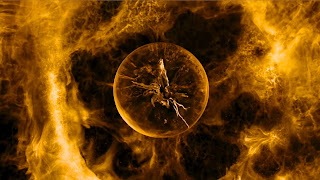
1.)Fragments from "The Chemical Wedding of Christian Rosenkreuts" translated by Adam Maclean: "The Fifth Day"This sepulchre was triangular, and had in the middle of it a vessel of polished copper; the rest was of pure gold and precious stones. In the vessel stood an angel, who held in his arms an unknown tree, which continually dropped fruit into the vessel; and as often as the fruit fell into the vessel, it turned into water, and ran out from there into three small golden vessels standing by. This little altar was supported by these three animals, an eagle, an ox and a lion, which stood on an exceedingly costly base. I asked my page what this might signify."
Here," he said, "lies buried Lady Venus, that beauty which has undone many a great man, both in fortune, honour, blessing and prosperity." After which he showed me a copper door on the pavement. "Here," he said, "if you please, we may go further down." "I still follow you," I replied. So I went down the steps, where it was exceedingly dark, but the page immediately opened a little chest, in which stood a small ever-burning taper, at which he kindled one of the torches which lay by. I was greatly terrified, and seriously asked how he dared do this? He said by way of answer "As long as the Royal Persons are still at rest, we have nothing to fear." Then I saw a rich bed ready made, hung about with curious curtains, one of which he drew aside, where I saw the Lady Venus..."
4.) [I am omitting as much as possible the description of Venus because she is too beautiful]1.) Last Fragment of Adam Maclean's translation of "The Chemical Wedding":
But I soon saw behind the bed a tablet on which it was written as follows: (When the fruit of my tree shall be quite melted down then I shall awake and be the mother of a King.)2.) The tree bears fruits, and the fruits of the imagination continue on and on to be burned or boiled, in any sense consumed until the system finally comes to an end. Even the infinitely productive tree of immortality must undergo an even greater octave (a denarius? 1-10-100 etc) of transformation. At the end of the tree's life, Venus awakes and becomes mother of a King. The very incarnation of beauty on earth... More terrible than we can imagine is that beauty! (This easily sounds like Isis who gives birth to the new god Horus but to me at least quite a relevant question: whether images, the gods themselves really, have to go through a death and a rebirth.) Just as the image of that yogi and his tree traveling through the endless volumes of space (One-thousand, two-hundred and seventy light years... give or take 76 light years... sounds like it would take MORE than five-hundred years according to conventional physics...) itself presents in the end that the images and the story, and the energy of the story are exhausted. I think that this is the most elegant space-craft yet imagined.
4.) In fact it is the most elegant space-ship imagined, and by this the most elegant bark to sail through the journey of the soul "Going forth by Day". There is something to the intentional skeletal nature of our current technology: the space ships from Kubrick's "2001 a Space Odyssey" through to the absolutely hellish, but effective "Event Horizon" (Paul Anderson 1997) have a brittle, skeletal nature. This is by intent. But a sphere of energy, a self sustaining garden is itself a sort of epiphany of elegance: much more capable of holding an "Astronaut" in a conscious continuum than the rather repulsive "Orion" (http://en.wikipedia.org/wiki/Orion_%28spacecraft%29) spacecraft we are fabricating at this time.2.) what is the connection between Xibalba and Orion?

Subscribe to:
Posts (Atom)
