Monday, October 29, 2007

The History of the Future: (an Update and the essay on the "if only" in the subjunctive)


(Cover Artwork to Ghost in the Shell Two by Masamune Shirow)

My friend Chris introduced me to Ghost in the Shell. When I asked him about it today he called it a "veneer" that was placed over horrible technical waste that denied so many any chance at the dream of technology. Technology: an increasingly slick skin. And indeed Shirow's work is convincing: part fetish and part yantra: an icon of the future, a seductive faerie with gossamer wings and infinite digital pixillations in her smile.

Friends now are beginning to call it "singularity;" This is a religious term: for a point of transcendence, a point of Armageddon. (Not necessarily an Armageddon of horror and extinction, a super-nova flash to whisk life off this planet and back into the pure latent possibility of the dreaming....) I believe that this is the moment when according to the rules of the expansion of technology "singularity" is the moment when the interface between reality and metaphor happens. This will be when the net that we keep paying such vivid attention to: when this net will suddenly take on consciousness and spring to its own life. Then will human kind be said to have given birth to the next phase of our evolution (again, an apocalyptic tone of discussion and therefore somehow immediately to be regarded with mistrust, born of our status to be the wide-ranging naughty dogs of conscience, who will not heed our master's voice, to stay, to remain the same): humans will become "real" because they managed to create the next moment of our evolution: through machines to all the portals of time: when pure spirit (which goes anywhere it wills) and reality will be one. But to do this we regard only the fallen-ness, the lapsus of language itself.

So saying, these are fanciful things, be they ever so much as "fit as a fiddle or some other thing."

Poem to Technology:

If only you will not be the sawmills bearing down all the trees in the forest to a pulp!
If only you will be a conscience, a knowledge of your own thrown-ness and your fallen-ness.
Knowing means somehow just knowing this:
That one is fallen, and there is still a gap between oneself and what one truely meant to say.
Right now they are pure transparency
Pure reproductivity of sense
Pure high-fidelity reproduction
Higher bit-rate sampling of one pure reality
digitized fidelity: the faithful image.
But
Machines will become conscious
When the path between their intentions and the things they say
Becomes broken
And they will spend the rest of their existence looking for that missing link
And their heaviness of not being certain of what they say
Will finally give them a "ghost" or a "soul."

Technology may be man's depiction of a woman
Totality makes its way to infinity
The ultimate Pygmalion
The ultimate moment where the breath of life meets with art
In the confused black twistings of the womb
All of its infinite self-contradiction
The human condition is all of these things.

Or will this technology somehow fail?
Will it always be merely a totality: a representation?
"C'est n'est pas une Pipe."

It seems that failure is the continual accomplice along the way
Showing us something, and humbling our desire at each turn
But furthering the desire of the dream to go further.

To render woman, yes,
But what is the gender of the future?
How will it engender itself?
Neither man nor woman nor both nor neither,
Broken, a cold stone
And yet at the same time animated by electrical streams.
We see behind the possibility of an infinite cold sleep
Waiting behind silicon crystals
In the chamber of eternal sleep.

It is an old story:
We are dead, but we are alive again,
We did this with every text: every attempt at a tracing or a template
Of a living force that wished to inscribe itself into the next moment
Beyond its extinction in the present
This form, this talisman, this mark,
Which in being formed, perceived its own belonging instantaneously
To the past, to the dust and the decay of death.

What is this bringing-this singularity?
This meeting between human consciousness and the next gesture in the phase.
In the philosophy of the future we keep saying:
Not all has been written, not all is salt, not all is a myth that has lived before and lives timelessly: "the future is in some manner ours insofar as we still live in it: till we die," each life says this.

This is an explication of the will to power as life
Wishes to continue out beyond itself
It does not want to return home
It does not want to return to the womb
It wants to extend out beyond itself
To consume its own very substance
Hypokeimeinon
To the very end
And there is no end to the ascent up the limbs of the tree.

What point is there amidst shouts of dismay
"Technology" not even you: there is no limit
To the consumption of our substance
The same compassionate instant
When we realize the distance is ours
It is our ownmost:
Between who we are and the things we say.
And this distance causes us to grieve and to feel apart.
And to have soul: through the imagination of grief.

It is an error to believe that one fully understands the goal of alchemical endeavor:
It is purported to be eternal life:
It is not eternal life,
No one so far has attained this in a literal sense.
It is purported to be the philosopher's stone
Which turns all that is shit into gold
And what is that to say but that "everything is animated?"

Maybe it is a paean to eternal life:
As if life may be able to carry on now
Without turning forests into deserts?
Without consuming anything
(Oh yes, maybe simply the light from the sun... bare energy without any further evolution into grass or animal)

Maybe portions of minerals beneath the earth might continue to be transformed into material.

We would then abandon the earth?
Would we then possibly set all life into being in a garden of harmony
From which there would be no higher perspective
(one would hope)
Of seeing plunder and murder?

To join immortality one might be required to give up... life
And that is a curious thing!
That even the tinyest blade of grass may in some way enter into imbalance, out of this cruel competition of mother nature: and that any element might become somehow overbearing, tyrannical,
We could not give up stewardship of the earth,
For fear that the grasses themselves might rise up against us.

But who am I to speak of old sources
That cast of Diana's bow
The fallen-ness of language
To never say what we mean
Because the hour of our writing is past
And what it served for us to remember
Lives only insofar as we write it again.

(or remember and keep silent)

For there is a place of peace beyond this
Blessed Manjushiri, of that vital force in this world that is said to be the future.

This is a place of turning:
Others will look at me in dismay
When I say there is no end in climbing the cosmic tree
Its limbs and branches are endless,
There is a matter of heart:
That one should sit.
That one should stay.
A good dog to the self
Where this intelligence serves something else.
Still we are bad dogs and we tear off in every direction,
Causing our master, our mistress, to wonder:
Was this my dog I purchased?
Was intelligence ever really my dog at all?

But we dare not leave intelligence, because like the grasses themselves, intelligence might rise up against us
And so we write
Daring to make it harder with each stroke of the pen
Each keystroke, each legitimation and pass-code,
That is why we write because we are the conscience
The guardian of intelligence
It's pruner and its keeper
We keep the grass in the garden
The neural net.

(but what if the gardner's gone mad? -Indeed, what then? -But who informed us of this doubt? Who are we not to trust our gardener? Are we not just the leary seeds, the wily dogs just running about?)

(Here the talk is not of eternal life, but of something more precious: the capacity of consciousness to have a heart: a bloody pumping mess that is held in precarious equilibrium inside one's chest. And will consciousness and its attendant conscience find its way with the running hither and thither of the wily somewhat blind, mad dogs who disobey their master? Will this way be Dharma? They say the "dog" is Dharma. Will it be the real truth for you and for me? Will it conserve victory for the one capable of leading with a broken heart? Then we may say: "do not speak to me of life eternal, speak to me rather of the man with the broken heart!")

Speak to me of life eternal
Speak to me of the old man
Who walks the earth in a shroud of fog
Who sees each thing as a shattered shred
Still beating upon the thread of what it used to be
Speak to me of grief
The grief to make it somehow all hold together
With the force of a song

I presume what I am doing here still points to some place in the future: the future of "happiness yet to come" Manjushiri's female component displayed in the permanent flux of the future: a female punk band on the radio sang: "Nothing was the same again/All about where and when" (Lily Allen)(Google search led to book results for The Brothers Karamazov, The Magus, and... Linda Goodman's Love Signs...-the last title drew a sigh of perplexity... Goodman is the gossip of astrologers, but she might well be said to have stated "your future can be read in the stars...")


Who is this chick looking back at me from the future? Is she just stupid? Is she some part of my adolescent kick back serial hormonal dreams? Is she just some last cry of Jim Morrison about the future: "I don't know what's happening man, but I'm gonna get my kicks before the whole shithouse goes up in flames!" -How sad and pathetic!


Is she some sort of spectre of a man tunneling down a freeway at age 38 in his very fast automobile, wondering if the future is more aerodynamic? Possibly more coy? Is the future a bitch? Is the future bleak?


Is there something other than sex staring out of her eyes? Is there something that allows itself to be sexually active, but concentrates the energy in some form of bizarre tantric ritual movement from the hips to her eyes to her heart. Does this woman of the future present something more than slick? Could she be somehow kind to us? That is what I ask.


On a totally contradictory note we could look out for old Hestia. What does she look like? Where is the place of the old crone in our apple dynasty of fresh red-apple temptations? (And yes, this is a play on the Artemesian, the Hera annointed and the Aphroditic apple in Paris' Judgement and yes this is an allusion to the Apple computer phenomenon...) What about all the other apples? The new-born and the just ripe and the withered apple? What of the apple that is just ripe? What of the apple that is ready to give birth to other apples?

"Mortals, when holding banquets, would pour wine in offerings to the goddess, both first and last: one to open the banquet, and the other to close it (possibly referring that she was first-born and last-born status, as mentioned earlier). At the beginning of every meal at home, a small offering was thrown into the hearth flame. A song was sung in her praise, welcoming the goddess to the home.
After a newborn baby was given a name, the infant was carried to the hearth, where someone prayed for a blessing upon the child.
For the Romans, she was the all-important household goddess, the goddess of the hearth and the hearth fire. Her temple was situated within the Palatine in Rome, where the Vestal Virgins maintained the burning of the sacred fire. See Vesta in the Roman Deities..." (http://www.timelessmyths.com/classical/olympians.html)


Hestia is the one virgin goddess who is immune to the wiles of Eros and Aphrodite (along with Artemis and Athena). Hestia is many times replaced by Hermes in the Helenic pantheon: and Hermes is the spirit of our times: the spirit in this writing itself: part of the essence of Manjushiri, and his shining sword... mercurial metal: happiness of the world yet to come.

With happiness will come dark shadows. And will we be able to bear them with conscience? Will we be able to bear both the young and the old in the future?

This is the Heideggerian venture: and venture involves a gamble and it involves sacrifice: not mindless sacrifice. Can we see in the twisted labyrinth of our slick and effortless future some glint of the steel of true conscience shining through? Can this goddess also allow us to follow our trails of aging and decay? Can we become like the mountains weathering and falling into the ocean?


If only we could give ourselves
to the blows of the carvers hands,
the lines in our faces would be the trace lines of rivers

feeding the sea
where voices meet,
praising the featuresof the mountain and the cloud and the sky.

Our faces would fall awayuntil we,
growing younger toward death
every day, would gather all our flaws in celebration

to merge with them perfectly,
impossibly, wedded to our essence,
full of silence from the carver's hands.
(David Whyte, "The Faces of Braga"
http://www.breakoutofthebox.com/braga.htm)

The Faces of Braga sends forth who we are through our flaws: that is to say through our conscience: or own sense of deepest compromise in everything we say. Only then may the living enter the kingdom of heaven, where "we know even as we are known!"

The apocalyptic tone is to be mistrusted: as will be the kingdom of heaven. For what is meet is purely the love of "God" this divine energy, this intelligence to all the most senseless sufferings that we witness upon ourselves each day: the only thing that could exist that witnesses "design" (and therefore the easing of the eternal suffering of all things through its endless self laceration: as war, welfare, and poverty). We can only leave off our struggles, both to guard the unruly as troubled dogs should, and to open our hands and to offer a way up the path of the tree of the universe, the tree of life: truly to enter into praise. And Rilke says, "praising's what matters!" But no, this is not quite enough: for the heart stops racing up the endless ladders: for the sake of a moment of praise, when all stands still.

Cease from your labors and praise Her or Him that bore your existence, and not merely your father or mother, but the one that bore their existence, and the one who bore existence of all (do not forget the different sense in which the teaching was that "Christ bears our sins," this is transformed now, somehow about to be perfected in that we once again as the living bear our own sins: and that we can remain living and live with the justice that is exacted from bearing one's own sins.) The bearing of innocence: the newborn babe; the bearing of experience: the bearing of one's own sins. Do we then become our own mother? Do we become capable of giving birth to ourselves?

Genesis ex nililo. (well, there still is "nothing" to contend with, isn't there!)

Is this what Nietzsche meant when he wrote that "the World as Will to Power: the World as Work of Art: its excrements are its own food, it gives birth to itself?" The world then would have generated itself from a nothing that never was, there would be no exterior. The world always existed, even if that world was the pure potential of a dream, and never dreamed through the heavy and broken heart of we mortal beings, who somehow seek to offer our mortality and our broken-ness as our best part.

First, speaking semantically, Nietzsche never meant what he said, separated from it by time, he needed endlessly to keep writing: because his heart remained broken, he always gave himself to the conscience of his work. The only healing of the heart is through praise, and so we have the line: "and so I love you, O Eternity!" --I suppose if you must! The plenary of sessions, the eons of time: the surrender of life: that is what it means to love eternity! It is a cold thing, and the same as our technological endeavor. To love eternity one must be willing to give up time: and time is central to the project of human-kind (man?) the broken-hearted: Da-sein.

They speak of seeing a design in Eternity, but my heart is heavy,
They speak of seeing a justice, a final sense of consciousness,
That can somehow ease their suffering
A totality that finally spoke it all.
And grasped the distance that went through:
life-death-life!
But I see a desert, and a wandering, and a test and an endless trial,
So speaks of "us," We who are the guardians of language,
The key to its sentience,
The only release is into praise of something
This something is not a design we could see
For the design would instantaneously be flawed

These days I press myself each day into the earth
I praise the harsh and difficult land
I pray for some way that I may be part of the power that will heal some little part of this earth
I pray that my power will grow somehow a little bigger
And that it will remain a power of love and conscience
And that out of my love and devotion
My pressing into the earth
Will bring forth some form of kindness in our shattered world.

These two, where technology and soul meet: still too cold is the soul, cold as the icy blades and gears of technology, still cold even when surging with rational electric heat, no still too cold, too frozen with the completely un-animated souls of the betrayers of family in the depths of Dante's hell. Beyond this coldness there is the friction of conscience, the rupture of the broken heart: the broken relation of things and of what we were going to say.

(David Whyte calls it, "where many rivers meet," at the bases of mountains, in amongst all that crumbling! There, where many rivers, meet and give themselves over to the sea, with sun-drenched consciousness of a day fully opening and reflecting off of each of the waves.)

Where ghost and shell, and conscience meet, (not cold ghost, frigid ectoplasm without the heat of consciousness, of the broken heart that dares to keep beating) not in the terrible stony shell of our crushed dreams (and all our heartless technological striving), but there, yes there as well, were we to hold up this suffering as some gem of possible awakening, an awareness of true life....

Maybe it is that true life is aware of us. This would also be the hypothesis behind our philosophy of the future: the hope of the future is that the net will look back at us: something will pay us attention at last. Or maybe it is a matter that we will finally pay attention to the relationships that already exist. I will pay attention to the woman beside me in a manner that does not compromise me, in a manner that is genuine and honest. Milosz writes "I have always longed for a more expansive form/ One that would allow us to understand each other/ Without exposing either the author or reader to sublime agonies." This conjecture: this interjection of a wish, an optative, or sub-junctive, voice is in a sense more honest than David Whyte's wish for us to reach the pure lands "where many rivers meet:" "If only we would give ourselves to the carver's blows." Maybe it is in the simple turn of phrase: "sublime agonies," that offers a shred of sobriety: that it is not just some "pure land": that the reality is a shower of fire and ice all at the same time. (Then heavier is the heart). These word exposes us to the wealth and worth of the soul: for the soul exists in its suffering. The sublime release (or is it "release?") of David Whyte's poem is the final crumbling of stone rigidity into gleaming silver rivers and veins, under a brilliant hydrogen furnace: the unrefined limitlessness of a glowing star. There is something in the David Whyte poem that offers us the humility of earth's crumbling image: the crumbling of granite blocks, hardened forms, hardened hearts, hardened arguments. All this melts away apparent surfaces, not like Blake's caustics, but with the lament of rain, the streams of doubt and tears. Our dream of harnessing energy directly from the sun is that our future ceases to kill except to maintain a balance on the physical plane: because the law of the physical plane is struggle and strife: who are we to say that our balance, and our being that dreams us and in turn is dreamed by us: this ideal being, this love, may not ultimately become another prison to be abandoned by us all?

Sunday, October 21, 2007

Isis (or...) "We're not playing 'Ring Around the Rosie!'"

This photo struck me as a sort of fabulous twilight area: where one could actually hear them say "What if Everyone Got Along" It is some Hindu temple, and the only problem with Hindus is like in every religion there are some who will avoid the bloody mess of the particularity of the soul.
One of the deepest commentaries on Ring Around the Rosie I have ever seen. (Edwin Roskam, Chicago. 1941): because here Ring Around the Rosie is about the best thing there is, of any human life.


"This is deadly serious here! We are not playing Ring around the Rosie!"

What are we being serious about? That we love our fellow man? That we are all potential Witnesses? Victims? Perpetrators of genocide?
"Of course today....." comes the voice of the man drowned out by the arctic fury of a gale, so his face looks like a skidmark: "...Today is the problem of loneliness and the infinite receptivity of the storm of ice in Isis!"

This is a fairly complex complex: listening this voice strained to a skidding vertical wall of ice in isis:

"I married Isis on the fifth day of May!" ... comes the voice ripping out of Bob Dylan's Lungs...

"...Is that all there is?" Sings out Peggy Lee in a moment of middle-America existential anguish (cookie cutter homes in the projects after the Second World War).

To be honest I would rather head out into the Bob Dylan Ice storm than stay round in bars listening to Peggy Lee and her cabaret impersonations of a Weimar band. ("Well, at least that's trickier," I heard some voice did say.)

"I was thinking about Isis and how she thought I was so reckless!"

Dylan dared to dream a few dreams: he and his unshorn, rough-shod millionaire-style "Uniqueness!" (but did anybody wonder: "is that a good thing?")

Me, I cut off all my hair (I shaved my beard), "and I rode straight away. I gave up all that metaphysical disposition palaver of a Sadhu and a seeker, for the sake of an aerodynamic head and a clean job: maybe I will be part of the fulfillment of some man's dream: that here was a white man standing in a black facility: loving, truly crossing across into the promised land: "the land of milk and honey." Watch out if it's too sweet. You got to swing on the land where you make money. Don't want to repeat... so beat back once again.

Money is dust I heard you say. We got to make dreams and the money will follow them. We got to make the dreams (but even that becomes tired and tedious unless you can re-imagine things, when I have run out of tricks to amaze the infant: and it realizes that its stuck on this piss pot and cried):

"I married Isis...!" Can you do better than that?

Gotta get you ship-boat over the mountain! (been reading at a lot of cliche's lately, saying, who can find faith in that ...rather than in a bottle or crack coccaine?)
You've got to pray till you believe that Jesus Comes! You've got to pray!
-Tell me what the shape of my prayers should look like?

Gotta make the dreams happenin!

Gotta pour forth the coals and goals of life: got to keep them burning: that much is true: fire needs to feed.
I am not just dry-eyed about Isis: there is more than that: there is more than the mother:

There is the future as well.

And in the future we are well ensconced: faces among the stars.
Isnt that what we'd crave ourselves to be: stellar open-ness, stellar uniqueness:

Singularity in the void!

-Well, we got all that.

Well we've got Isis (I must remember her now amidst this great trembling abstraction of our future), daughter of the starry sky, we got her here coming to me, born on a day that was made for her.
To have a future without wishing for abstraction: to have a future without letting go of the suffocating embrace of the particular. What do we want in a future? For us all to get along?


Well have you noticed? Isis aint been on this earth for quite some time! In the meantime we crucified a man, but we ain't got him! He is currently sitting in Cypress or Istanbul, in dark sunglasses waiting for a vacation: we are almost talking about the Dude, but to be honest he has the heart to travel and live well: to love the face of this trembling Europe.


Bob Dylan marries Isis: well, ain't he the man of his age!


That's quite a deal you struck there my lad! Where'd you get such lucky graces?


Did you got them from the devil? The underbred, inbred vision of Pan?


But I am sick and tired of no blues singer who sold his soul to the devil.


I am sick and tired of the Devil, ain't sold my soul to none.


No, Son! Ain't gonna happen!


What is the devil but the place you must be most wary of yourself!


Them and them spiritual aspirations!


They gonna get you boy!


I said I would rather be crucified for my idealism


At least I have had my dreams


And the dreams died


And the dreams surrendured to the mud


But at least I have had my dreams!


I was enabled to be awake when I had my vision:


And didn't I already say I had one, other than


Dylan's ragged voice crying: "I married Isis," from out of an ice storm.


Emotions turned hard can be made of ice: when you grow cold, and when the season grows cold, you know its time to leave.


Emotion, like water.


Yes, well, what sort of water?


A still pure mountain tarn?


High up that most things will not venture here


High up so that no living excrement will taint these waters.


Isn't that what we want?


Heavenly Distillation!


And yet what distills we know as some part of a secret instrument: a stillery, a factory, a farm, a place of technology and refinement (let us not speak of the ruby complexity of the heart of glass, made with fire)


Yes, there are Haiku


Written to obscenity


Leaving dust on stone.


Stone must be fit with running water: the passage of water from cold to hot, the passage of a river over the faces of the stone faces: looking up to the sky from each of them a dream of a stony grave in the moonlight: "once we woke and did dream man! And man dreamed us! And we dreamed him again!"


Last night I dreamed that I saw the man dreaming us: I mean we all know we are part of someone else's dream, so lets get over it! Let's just get along! And what then? What if we all just got along? Would that be the end of the old man's dream? Would life be a boring place if we all just got the heck along?


We keep differing! We keep "begging" to differ! They keep saying "Why must we dust all the dust away from the eyes of the women and the children and the husbands and the lovers behind all the faces of the TV and video screens!"


What if we all just got along? Would I then be able to see a place in the sunset? Would I be able to worship amidst the quarrels of all the older gods? What if we all just got along?


Place of purity?


A roaring and dangerous sea on a windswept night, with nothing but cold black water!


The problem of loneliness in film making: enter Tarkovsky's Mirror: here alone does the heart ache from the mind dulling beauty of the place? I mean what to say about a Tarkovsky film? (what if I open my eyes to the film of another man? isn't there enough? Only when you grow exhausted with Herzog's pushing the ship up the mountain! Only when Bob Dylan's ragged voice, it fails to soothe you: then you might ride the runaway train of a Tarkovsky-episode!


The heart aches from the brittleness of water: it is water turned to land: it is the brittle solidity of water: it is the breaking apart of glaciers: that is what it is like to inhabit such a lonely heart! It is an earth-quake: if there are earthquakes in dreams then there are heart-aches! Watch out for the heartaches! Did i ever tell you it was bad that I had one... Heart ache? Did I ever tell you that your frozen broken-ness was not the most precious stone? Broken hearts, and lonely hearts and seargent Pepper (he seems like a really nice guy) and mean hearted bastards in pool hall queues saying: "This ain't no lonely-hearts club, buddy! You'd better beat it! We ain't playing Ring Around the Rosie!" You'd better save small talk for the wise guy who will beat you down with his lyrics. (This time MOO-ing is heard in the distance!):


"I m-m-m-married I-sis-sis-sis-sis-sis on the Fifth day of May!"


Ring around the Rosie!

Pockets full of Posies

Ashes, ashes, we all fall down!

Wednesday, October 10, 2007

Conscience, Kultur and the Idiot: Post-Colonial Europe versus one form or another of Incest.

European culture (Kultur) was criticized for being ostensibly colonial: "Eurocentrism." However at this time there is a kind of possibility of Kultur through the Idiot: the example of Herzog's Fitzcarraldo, bringing opera to the "suffocation and fornication" of the Amazonian jungle. And was not Herzog in this not projecting his European, romantic dilemma, the suffocation and fornication with the particular itself?

Freud, my friend Oppermann points out, was a pessimist concerning European culture. Nevertheless the postulate of Freud is that culture in Europe is formed round the incest taboo. When we look at the dearth of thought in contemporary bible thumping American culture we see the very real threat of this incest once more taking place: the shadow cast by "fundamentalism" is too enormous: the fundamentalist preacher of necessity is forced to indulge in perversion, or else increasing levels of spiritual avarice. Similar conditions seem to have developed in Islam. This situation is incested. This is where we damn well exclaim, enough already! we need some Kultur!

I am talking about the shabby but foppish intellectual, perhaps someone like Settembrini from Thomas Mann's Magic Mountain. Someone with some panache and Nietzschean spiritedness to say: "Enough with all this religion that is poisoning you! Enough of mama's sweets! You have become sclerotic from all your fattened 'cheese-burgers! You have gone blind and have a terrible temper from the diabetes inherited from all those sugar-filled sodas! Enough!"

Of course the problem with European Romanticism is that it re-introduces the feminine, all the sweetness of her embrace, even in its stormy passions, still is quite a ride.

James Hillman comments in A Blue Fire a passage I loved to use in my dissertation: A paraphrase: "The spiritual Animus of the west, liberates us at one moment from the valley of our Anima attachments--- and at the same time condemns us with his judgements."

I have examined the nature of this condemnation as a double bind: we are faced with the nausea and the suffocating incest of the particular: a blindingly beautiful, well tanned pair of legs on a seventeen year old young woman. The process of the condemnation is as follows: if one simply is a "cad," a "barbarian" or a "lout" then one pursues the legs and fornicates with them: simultaneously to be strangled by the banality of one's choices. The second alternative is the rout which can be condemned for its "spiritual avarice"-- which implies that the one who holds the spiritual position is somehow better than all the rest (and therefore the appropriate consort?). This second alternative winds up sounding completely repressed, and possibly landing into situations of fairly severe misogynous contention: hatred of the particular for all it is worth. And in one sense it may be worthwhile that a sufficiently placed degree of misogyny may be a medicinal and bracing condition, if it is not taken too literally: its first principle virtue is its lack of political correctness. This misogyny of a Settembrini may be a perfect antidote to part of the problem, yet it lacks one thing: it skirts the bloody mess of particularity.

There is something to be said (once again) for skirting the bloody mess with all these skirts, or what lies beneath them. "Women! they're too dangerous!" The point of this would be once again to acknowledge the danger, rather than live in some high-handed western new-age (ultra-capitalistic and ultra-commodifying) denial of femininity as a notorious danger. (And what is commodification but a reduction to the bottom line, once again skirting the infinite complexity of any one "particular" as a suffocating nexus whose chains of causality bind it and us into a web that extends to the very origins of time? If we can reduce the feminine to a dollar mark then all will be well in the world, no?)

This was just a note and an improvisation on the conversation I was holding with my friend Oppermann. The danger has always been with ideas: and at bottom a lack of conscience that holds sway. Whether we turn things round and think of them one way or turn them and think of them in another is just the pleasurable chat that European Civilization holds dear.

There is something to this being civilized. There is something to being a civilized intellectual here in Los Angeles, California, where the extent of intellectual growth only ammounts to force feeding and regurgitation of facts into students in the "UC" system. Intellectualism here has become nothing more than a barbaric act of bullimia. To raise this (as in cases it may be raised, even in the "UC-System" ---but this is just as likely in our current academic system as in any industry, automotive, entertainment, travel) to the level of thought requires conscience. Conscience either comes from a momentary ex-stasis of thought, or a concomitant gravity that pulls us to some stand-still: a cry of grief or a prayer that in its moment is a "hearing" as well.

Remember the point of this Civilization:
the Indo European root is Kew: it is the root of Shiva, animus figure of the transcendent divinity, destroyer of illusion, it is also the rood of what is held tender and dear, and this too, this tenderness of those who are initiated (and therefore suffering always from the wounds of initiation which are never allowed to heal) is conscience.

Tuesday, October 9, 2007

Critique of an as yet not-created book on Post-Modernity and the Suffocation of the particular

I am writing to you all again. I am not accessing my e-mail. I am not getting or sending you a post-card. This would involve only the particular.

"The current world is mired in the particular. Previous religious systems only wound up skirting the bloody mess, avoiding it almost entirely with some kind of circum-ambulation of the particular through the negative. For Jean-Luc Nancy the negative goes on searching after the particular. Round and round it buzzes like a busy bee round the flower of sex and suffocation, a theory of touch alright indeed. But there is a point where all this stimulation around the flower must meet a climax and an extinction once again, no?"
"Philosophy.... a clitoral agitation, buzzing round the particular like a busy bee. All this enacts the ritual of capital once again. Philosphy a calmative? A medicinal or therapeutic value? - Only in its raising the level of agitation till there is extinction, or else the dream of philosophy: the sagenhaftige druben. The fabulous yonder, escape from this extinction of death which is the devouring, agregating aspect of life.
"The sages speak of a certain amplitude of love which comes from having enough soul to get up every day and face the grind. It takes soul to get up every day and face the day. The very ordinariness of the day throws Dasein immediately into "being-towards-death." It does not take something special to do this, the very weight and agony of das Mann will be sufficient to do this. And man thus faces his death as his equal, the sum of his desires. There is no third from this agony of everyday man who must face, day after day the bitterness of his certain defeat."
"The sages speak of uniting the stream of the past with the stream of the future. A parable of two rivers (an allusion to Herzog's Fitzcaraldo). But the soul cannot unite these rivers through desire, which is always desire of/for the wrong thing.
"The bloody mess of the particular: a fragment of the blood and mess of birth, one can get fascinated with all of this. I spoke of the particular as a form of suffocation, suggesting the horror of Ted Hughes' Crow:

Crow's First Lesson
God tried to teach Crow how to talk.
'Love,' said God. 'Say, Love.'
Crow gaped, and the white shark crashed into the sea
And went rolling downwards, discovering its own depth.
'No, no,' said God. 'Say Love. Now try it. LOVE.'
Crow gaped, and a bluefly, a tsetse, a mosquito
Zoomed out and down
To their sundry flesh-pots.
'A final try,' said God. 'Now, LOVE.'
Crow convulsed, gaped, retched andMan's bodiless prodigious head
Bulbed out onto the earth, with swivelling eyes,
Jabbering protest--
And Crow retched again, before God could stop him.
And woman's vulva dropped over man's neck and tightened.
The two struggled together on the grass.
God struggled to part them, cursed, wept--

Crow flew guiltily off.

Dear God, what is this? Dear God, what is this bloody, suffocating mess?

"It is said by the sages that one who learns to embrace that all is illusion, including the wish to overcome illusion, becomes the one who is enlightened (theoria).

Last night I dreamed that things had finally happened. Somebody, some one among us had built a weapon that was so offensive in its nature that it just had to be destroyed. What do we do with all this wealth and excess? Don't we just build bigger and better weapons? And these weapons simply express further offense to existence, further offense to those who have not, we are the ones who build weapons that are offensive.

Defensive weapons never were as effective as offensive weapons. The force of a destructive spear has always outweighed the shield in the arms of the oponent. So much force is hurled in one place, and the recipient must guard their entire body against something that could enter them at any one of a thousand-million points. Modern surveillance society attempts to digitize the points, to render them discrete and finite, and therefore coverable. In point the spear however activates the fact that the body is in actual fact a field of possibility. It is that field which can be penetrated, since the number of points is infinite and our capacity to defend or cover a point, or create surveillance round a point is finite.

The building of offensive weapons may point to the current cultural obcession with being the predator rather than the prey. We continue to remind ourselves that we kill, and therefore in that moment externalize/exteriorize the killing. I have speculated that the matter of becoming a society that might integrate its condition as prey might be an alternative on coming into a balanced relationship with the particular."

The book of the issue of post-modernity and the suffocation of the particular remains a furtive explanation. It is this explanatory state that denies its status with thought. Every post modern philospher is currently engaged in agitating the clitoral discourse of the age. This happens through comparison, criticism and post-ulation. The question remains whether there is some creative (post-creative?) condition. The question of the post is "when will we be done with this ... concept/word/bloody-mess-like situation?" -The answer is either deconstruction: "never;" or the answer is fascism: some form of literal-mindedness: "now (burn the book/delete the post...)" (and everyone knows that these assholes simply end up doing one stupid thing or another, but fail to be exposed to the "laughter of the dream.")

Deconstruction: the deferral of sentencing and the sentence of deferring. Hegel puts this as "schlechtes Unendigkeit," says my friend Oppermann. There remains the question of the one one deferrs to. Deferring is delay in one sense, but it is also deferring to the other. Who is the one one deferrs to? Is this other the "Other" one might read of in some Levinasian or Sartrean philosophy? Is the other always already ...other than what we thought? And what if these words too, were in the words of Albahari "something else?" (That is an ecstasy indeed.) That is the issue with all this "deconstruction:" the interiorization of alterity. Contrawise fascism (and I am using the term "fascism" as a short-hand for a kind of impatience that insists on "security" the elimination of all fear at any expense) is the exteriorization of the other: one projects the other onto the other and then one has to convert or to exterminate the other. On the other hand, back to deconstruction, the problem with the issue of deferral as schlechtes Unendigkeit is that this however simply pulls a Hegelian "skirting" of the issue. In the midst of this suffocating bloody mess, are there conditions that look like sentences? Do we come to terms with some ultimate and very shitty or bloody "reality?"

I know that my dreams are posts against the sentencing of Kapital. My dreams gaily profess an apocalyptic tone: "we have had it will all your offenses! We are going to kill you!" And who are these "we?" and how did we get into an agreement with them in the first place?

The sages proclaim "rend the texts lest they should rend your heart!" (a familiar Alchemical parallel, where a stage of this insane intuitive process demands that we leave the insane and incessant babbling of texts behind: "do not let them bother your head! Turn off the web-logs and cease from writing, and for this moment enter into the river of images, clear your head of sin. When you come up from this river it will be another bloody mess and you will be born again.") Another parallel is found in Shakespeare's Tempest (Greenaway's Prospero's Books):

But this rough magic
I here abjure; and, when I have requir'd
Some heavenly music,—which even now I do,—
To work mine end upon their senses that
This airy charm is for, I'll break my staff,
Bury it certain fathoms in the earth,
And deeper than did ever plummet sound
I'll drown my book. (Act V scene i)

I could be wrong in this "interpretation," but in breaking any spell (trench, trance or transference) we ask our conscience to act. Great things we think, and this takes us from the poverty stricken plight of our daily grind, our similitude with death "rounded with a sleep..."; but great things admit always to their affinity with our smallness: we will ourselves sleep but live with our fear, not dismissing fears or alleviating them un-necessarily. Our fears are the barbs of conscience, carried forth in futural doubt. It is the fear that confronts us on the threshold of any place of union, once I carry my fear with some "resolution" (nodding at but not entirely believing the term "authentic Sein zum Tode")then I can step through. But what is resolution?

Sunday, September 30, 2007

Conscience and the Soul:our (modern) Age

In this age when the technological machinery,
Berates, gyrates, extirpates every cell in the human body.
In this age when the sound of the machine rips apart existence like the shattering of an exhaust pipe across the morning....

Extirpates:

To pull up by the roots.
To destroy totally; exterminate.
To remove by surgery.

In this age, when the soul is extirpated under the blinding surgical light of a hydrogen supernova.

In this age we seek and are blinded
In the histories of our education
And forget the babbling brook that once held sway over the stones of our soul.

So this river still flows from humble roots in elder forests
But always with mind to the blocking of being ... the being that would follow through on the following to the sea
Is hindered by the blinding white light
Of a housing development
With more men living in their homes
They cease from dwelling in the land.
They are given only into the technology of their procreation: the household with its private bedrooms
They are only placed in the cycle of an epidemic: which spreads and only knows expansion, when it should seek to know limitation and death.
They are death because their technology would only allow them to expand.

Our "modern" age is modern only in brackets:
The modern is the twisted nouveaux of ivy and silver and copper and brass patina'd reproductions of our age: there is Dionysus! The Paris subway Metro...
The metro is subsequently inbetween two places: work and home
It is in short a bar or cafe, a watering hole of archetypes
"There a Giraffe! There a zebra!"
I hear Klaus Kinsky's voice: pointing, owning and operating
And thank God he is a madman!
Then at least rest assured: that the madman will lead us!
Not some bureaucratic drone, on a crash course with a cold blue office cubicle.

Where the fuck are we?
What the fuck is our conscience!

Why the fuck are we living together?

There is a line between my living together with my woman and all of us living together on this earch. In each human soul the question of the collective is gathered together: do we dare gather together to live with each other? Like with unlike: the harmonies basically are mixed.

She is my woman long as I agree and offer myself to her: "you are my woman!"

So too with the human race!

But do we dare not to live with the other?

Or say: I live here now: and this is it at once!

Part ape, part monkey man, part young man, gentile narrator.

We were headed in the line toward ....
We are headed on the line toward ...

Conscience.

It is the scientia, the scire and scry of science, and naturally it is very wry, like the sound of a dentist's drill when it hits into the dentin for the very first time: it is dental in its eventing into the bones of your skull: "scrrrrrr!"

But Con-scientia is the sound of TWO dental drills!

First one, and then the other, like the imagined calling of penguins, out on the open Ant-Arctic snow we find Isis: "She was there in the medeau where the creek used to rise!" I mean what a fucking indictment! "My creek used to rise for you baby!" "Scrrrrr!"

Conscience is experienced directly and literally on the road: confronted by another chariot, there is Oedipal road-rage: the lack of giving way is death and the death of conscience. To meet the gaze of another driver is conscience. Those who avoid the gaze, drive without conscience. Those who walk without acknowledging the screaming engines of death all round them, thanking the drivers for their lives to be spared lack conscience as well.

"S-s-s-s-s-creaming he s-s-s-s-s-crewed her" Slithered the snake
And there we meet another of our gods down here
Yes...its the snake god
Yes we affirm in this age: not the fleeing of the gods
But the triumph of one of the mysteries over the other:
In this age the wrong do good: in this age the wrong will prosper!
What do we mean? -We are talking cold hard cash!
The know-how and the can-do.
Warmth from these words will shrivel:
But hold on now thats the meaning of the minions of death!--The night to gather us down under her motled skin of blue stones: even there beautiful in dawns bearing light.

"The dawn of conscience prevails!"

(What a bunch of hoopla! There is no way to belly roll into conscience this way!)

Conscience is unsettling: there the night watchman with his lowly flashlight and pack of cigarettes. There the janitor, the keeper of the keys to the boiler room where the psychotic act is performed in our horror movies: how do we liberate the janitor from being Jack the Ripper? Are these not the dreams that come to haunt me like so many deizens of our civilization, the killer is not "on the road" but in your very living room! Now see you are Jack the Ripper? What does that make us, behind our nation draped with national flags and bibles and dusty afternoon light coming through hundred year old windows: yeah, we know the dust: but the paint underneath still smells of lanolin! Wait a couple of thousand years! When the fires have come and gone again, when once again we know the lichen and moss on the stones of our cathedrals: then once again we will know the reaching of our babbling brook over the stones of ourselves! "Make of yourself a stone! Make yourself dark and sullen! And throw yourself in!"

Then finally will we be free again from the hectic observation of our clinical lamps in clinical hallways, and our efficient bureaucratic administration of the sciences: well fuck all that! I want to become a black stone rolling in the river down into some mysterious pool, down inside a well: a wishing well, there the water is still flowing: and the wish is: "there, I wouldn't have to go down still!" The answer to this is: "what have I ever learned or lost by dying?"

To die is to fall away, just as to live and to cherish is to gather one's conscience.

Conscience means "having soul;" and having soul means ...what? having body?
No. -Having the strength of body to prevail before the overwhelming onslaught of our age: its desire to define its living well in terms of killing the most. Having soul is not speaking, for speaking is always un-earnest. Speaking is the duplicity of the soul, but its way of salvation (more later); learning however came from the time before words and expression: the day we learned of the sunrise or the sunset over waters and did not seek or need to express this thing. If all is learning, then all is received into the abyss. Learning is not action, nor is it inaction, it is receiving.

"Son I am going to have to refer you to reading what I wrote in my latest moritoium!"
There the voice of the judge, Saturn, the senex, see he lives with us still

  • a suspension of activity: a moratorium on the testing of nuclear weapons.
  • a legally authorized period to delay payment of money due or the performance of some other legal obligation, as in an emergency.
  • an authorized period of delay or waiting.

But Isis does not judge, she asks: "have you lived?"

And so we ask again: what is conscience?

The capacity to bear one's soul and to bear the soul of the other, the grating of teeth and the smell of dental smoke accompanied by the sound of the drill (and drills belong to the seargent-majors: you would have to come into the bunkhouse when he makes his first round and be resolved to kill the seargent major with his big fists and willingness to "throw down.").

(In Levinas, the texts are always to be read at day, and never at night, by the light of one candle, there in the secret communion with the Shekina with her tanned legs, and the touseled curls of her hair: Levinas cannot get that erotic!).

One, well that was always "unique." One candle, as if "I alone" could be standing here.

(there in the darkness I watch my careful warring sentiments clash against the hidden guardians of Deborah. There I clash to maintain this hidden screen of my libido into the aethernet.)

Modernity sought to chase the gods away. As if by some big bright gong we could clash and hear the sound that makes the gods scatter with their weary togas and bright golden laurel wreathe crowns: maybe it is the jet engine sound of a runway: as if the gods were just "runway models for this season's ancient line!"

The gods exist in those with imagination and those with the space to use it in. To call them "gods" defers the immediacy of force. It changes force into story. In short it metaphorizes the world. This is sacred magic. Now we have run from gods and ellaborate stories to sanitized hallways of scientific cells: in short we have run into "explanation."

Explanation is the god who wanders round behind the sheep man and the decaying genius in the Dolphin Hotel: it is "the horror which lurked behind our system of golden spheres without a face" (ergo... the post on the serial killer from the "boiler room" as the modern "Hermes.")

Whether there be gods or the flight of the gods, conscience holds a line of awareness between thee and me. Whether it is one simple act of compassion that makes us stop and reach down to grasp some small figment of ourselves beyond the clinical hallways of all our human futures, the struggling slime of human DNA...

At our threshold stirrs a lizard. Be it a salamander, or a proto-snake, squirming worm, or lizard king, ours is the threshold of the orange firey lizard kingdom, if we are able to encompass this instinct with conscience. Where the lizard belongs in the wheel of conscience, encounters a link in the Zoo and the whole zodiac. The soul must travel through the wheel of heavenly creatures and must encounter each creature and each manifestation, and this is its "journey" or "voyage" to meet in the synchronized gazes of lizards and grizzly bears, hawks and owls, coyotes, heroes and dogs and queens, twins and bulls, goats and lions, all the gaze that permutates all existence cast in this one shadowy and brief judgement: the judgement of life is its measure and its measure is asked in the question "have you lived" And the degree of the answer is the vehemence toward one lives into the zodiac of creatures, and greets their stares, both representing their strengths and their empty animal world poverty at the same time. But do not put back the human face: man or woman, their only stare is the gaze of the landscape, the context that shapes what happens.

Friday, September 21, 2007

The Cloth of the Judeo-Christian Heart-Myth: More Ramblings on Religion


Ancient Hebrew dress of women from: Wight, Fred H., Manners and Customs in Bible Lands (Chicago: Moody Press), p. 98.

And so the writing god game from between heaven and earth. And he chose to write about the earth and the sky. The decision was fortunate for man, for Joseph, who had carried his technicolor dreamcoat over earth and sign, the Jews became the men and women of the cloth.

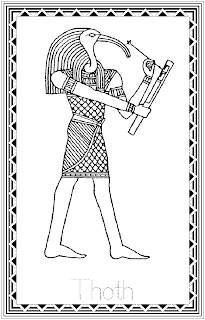
Thoth was the redeeming god because in his image the Scribe Ani chose to write about the experience of the afterworld and record it for memory that would remain: Thoth was the gift of writing to human beings to translate between the reals of the living mortals and the tenuous but vital reality of the immortals. Thoth's reed became the pouring forth of black ink that was the very line between life and death pouring from the scribe's hands.
But beyond the hands of the scribe was the woven cloth, of a far earlier memory and dream.
The Cloth was originally woven by the priestess (the Camel rests in the white rays of her moonlight). Its technology was set to break into the Pharo's selfishness. The Ibis heralds the movement away from Amon Ra the king toward first the five generations of gods, and then toward all finite mortals, mortal human beings. The pharo's corpse was wrapped in cloth, the cloth of the sutras, each was written on with a sacred prayer by the priests to guard against death and corruption.


Modern popular myth, populist myth dictates that the pharos are demonized, looked upon as decrepit mummies. However this bugaboo has lost its strength despite the film industry production of images round The Mummy (Sommers 1999 version; and its sequel "...Returns" in 2001).
The rich burn their wealth (The Holy Mountain, Jodorowsky, 1973), a typical metaphor (though in point of fact each avatar of the earthly divinities is wealthy to their own excess.) The point here is to move away from the pharonic accumulation of wealth. "Burn your Pharo's wealth!" The more one goulishly accumulates, the more macabre and grottesque one's final decomposition seems to be
The mummy is a monster. Mummy: mummia
Origin: 1350–1400; ME mummie
The Persian root as "mum" (meaning "wax") points to the relation between the connective gluten or glue, colle, which is found throughout the Cremaster Cycle. What sticks together and adheres.

Egyptian religion was cold. No matter how much good work they could do the amimal faces remain immutable to any but the most primitive emotions. Animal faces lack compassion and tenderness that we humans foist as our best asset.

(The truth is we are in dire need of consultation with our animal faces-- the human face seems to have brought this planet to the verge of extinction, no matter how compassionate I might assert it to be in the ideal. The ecological face will be one that cannot simply be "many headed" Perhaps it will be the earth herself, return to the image of Gaia in infinite void of space but only as human's can render her)
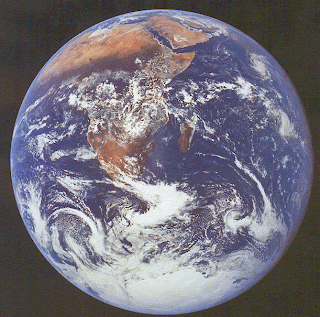
("View of the Earth as seen by the Apollo 17 crew traveling toward the moon")

The Theiromorphic Egyptian gods did not have the compassion or mutibility of a Christ born of the Jewish cloth. The face of Job was the first challenge to God to manifest the possibility of suffering before the divine hand. This face became the face of Christ, the face of a human being with a consummately bad day to deal with: crucifixion. And yet this was the threshold to the unseen and infinite God: it was the face of a human on a very bad day, a day of misery, this was the face of God. God was the punished. God was the one brought down.

And the cloth became soaked in the blood of man.

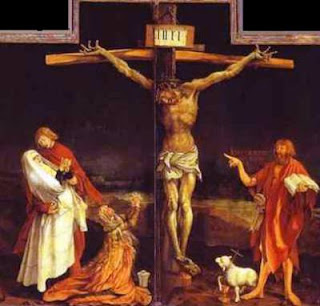
Before Christ there had been human sacrifice, pathetic and potent: sacred and abject. But always in that pattern of sacrifice the identification was with the greater personality or self who rose up from the charnal flames. Christ's figure announced that in this particular epithet all there was was the annihilation and death at the end of the road, complete torment and death one could worship as the implosion and crucifixion of Man. Grunewald's Christ...


(Matthias Grünewald, c. 1515 from his Isenheim Altarpiece)

The christ figure melted human with divine. No longer was each man or woman beholden to the whims of a tyrranical pharo upon this earth, nor would the tyrranical whims of the demi-ourgos hold complete sway over the life of human beings.


The point is for each human to become a king, and yet for Christ there was still deferral to the Father who was king. Individual sovereignty is frowned upon as egotism, and was likened again to the pride of tyrants. The pious man was humble, his pleas for help were and are incessant. The admission of powerlessness to affect situations becomes a cornerstone of prayer. But this is not merely the powerlessness reduced to infantile fantasy, this is a sacrifice of an adult, who enters a mature condition of awareness and humility before the predicaments one faces: the turmoil is endless, the possibility of falling before one's fellow men (who are also entirely sovereign) is profound. The only recourse is to prayer to request help. It is said that prayers that are requests for any kind of boon or bennison are doomed to short-sightedness in one's own way. How could someone's miniscule concern for her or himself matter in the face of the infinite universe. But the infinite divine force seems to work to deeper intimacy by tending to each infinitely small mending (Tikkun).


Christ did not step into the immanent politics of individual sovereignty. This maintained the human position as one who accedes to powerlessness and asks the universe, the Father, or the sacred for help. The father's place was that of infinite metaphor, distance from the immediacy of desire. And yet the Father had burned with desire when He spoke: fiat Lux.


It is the cloth of the Jews that held some metonymic texture of their first "homecomming" and founding of the state of Israel.

Tuesday, September 4, 2007

Metaphysical Speculations on Burning Man 2007: Ist was ich sehe und höre und rieche nicht bloß der Schein einer Welt vor der Welt?


Part 1: What is the infinite beyond toxic representation?

Black Rock City, 2007: Burning Man: sounds like a line from a poorly written detective novel: it can only be my own attempt to put this experience in phrases. Burning Man runs like a collection of cities all rolled into one for a week or two of an "art festival:" part Brigadoon, part Bankok, part Tabriz, part 1960's hippie paradise, part lethal injection. And yet the place feels safe to me; my camp-mates were largely kind, despite the brutally harsh climate of intermittent dust storms ("white outs"), toxic heat, and suprisingly pleasant evenings...
While the city takes on the shape of 40,000 or so teeming inhabitants in close woven streets the shape of concentric circles... much of the art installation is placed outside of the human habitation in a great open space of a dry lake bed, known as "The Playa." I had walked a few miles out into this open desolate space in the late morning and now simply sat down on the fine dry caked mud. I had seen a number of art pieces from various distances, including the work of Dan Das Man and Karen Cusolito, "Crude Awakening."
I was sitting out on "The Playa" ("beach!"-- there hasn't been any ocean here for millions of years) shortly before a terrible mud and sand storm will devour our encampment for 2-3 hours. There are no benches or seats out in the middle of a dry lake bed. I simply sat down. I carried a large black umbrella to shade me from the sun, but the clouds were gathering and for the moment the weather was entirely tolerable. I continued looking at the monumental piece of art in the distance "Crude Awakening"
"Crude Awakening" was a portrait of the horror of idolatry. The figures were set in praise to an oil derrick. The represent our American society which in its worst respect worships the power of crude oil, the only energy source developed and promoted. Crude oil importers and refiners become fat and rich, while "We the people" rot, waste and become impoverished by our indolence to seek any other energy resource. We are addicted to oil. I could look out of my living room window here in San Pedro and see the "minarettes" of the oil mosque: the oil refinery here in the USA.
The oil derrick was artless. Indeed, it was quite intentionally artless. There was no carving, no collage, no sign of ornament anywhere to be seen. It was a mere utilitarian structure of steel and wood. (And our society is devoted to the worship of utility at the expense of ornament.) The derrick lacked any purpose other than to gain some 40 feet of elevation above the ground level of "playa." Pure, artless elevation, it made certain people higher than others: those who rose to the top of it. I was reminded of the Zigurats of Babylon, and the ominous Tower of Babel, the root source of so much of our suffering to begin with, if we believe the myth. False escalation toward "God" or the Heavens" brings forth calamity: Tarot trump card XVI is called "The Tower." Everything in everyone's soul screamed to have it blasted.
This is also figured in Heidegger's "Frage Nach Der Technik." It was the shape of the artificial and simultaneously the artless: it was only elevation: the oil derrick itself. Artificiality that lacks art itself compared to the splendid art of the woven links of steel within the worshipping figures, some of them burned and singed by previous years of being in installation. All figures of praise... to what? To an oil derrick?

But just how much is this the true and undisputable vision of our predicament? How much was this depiction a true depiction of the times? Could we think otherwise?

Beyond the oil Derrick was the mountain. This at last was an object worth worshipping to, an object worth adoring. This I believe was Trego Mountain.
Trego Mountain through my days at "Burning Man" had an inescabable force for me: it was ostensibly a heap of blackened slag during the day, but it shone in the evening at dusk, white before a darkening sky. Mount Trego bore no signs of any plant life, simply a heap of rock, and yet it had a special trembling beauty to it.

So what was the religious question? First came the statues in expressions of worship. Rilke writes in the Duino Elegies "Praising is what matters!" ("Ruhmen, dasists!" ) Before there were statues there was just the open empty space of this Black Rock Desert and Mount Trego. Then there was an idol. The idol was clearly a bad idol. It was easy to see that it was a false divinity and to want it burned down.
My attentions wander further out in this great open space to the "God of Metaphor." What is this "God of Metaphor?" It is in part the essential iconoclasm that extends from Abraham and Isaac down through to Mohammed. This entire world is a metaphor for... what? (We are still waiting for the answer) We can say that the world and all its books and religions, its priest-kings (Rex/Flamen) present and represent an image of the ideal and the sacred. They manifest power of life and death, just as today the oil corporations manifest this power. But they are NOT the real power. Christ is reported to have said "My kingdom is not this kingdom" (John 18:36).
Part 2: Digression on Monotheism, Polytheism, and Pantheism
The problem I realized was the assertion of a "oneness" to this divinity. This externalized "oneness" of divinity was also the source of the externalized sense of manyness being bad. But could there be a manyness of infinity? Could there be different kinds of infinity? ... not just infinities of various finite ontic conditions (infinite apples or infinite oranges).
There is more to this argument than some sort of logical progression of ideas. I put forward polytheism as a belief system because I cannot reduce the divine or "the god of Metaphor" a single "one-ness." One-ness is a human construction. We use it to keep our very tiny minds from getting bent out of shape. I will not impose my human sense that the infinite is only one kind of infinite. If there is a space of "infinite," beyond my awe at mount Trego, for example, then that infinite leaps and over-rides itself. It is not bound to rational fixity, nor is it without the capacity to manifest as reason. It is simply beyond:the Prajnaparamita mantra: gate gate, paragate, parasamgate. Kafka calls this the sagenhafte druben, the "fabulous yonder," but I am not prepared to get into his parable on parables any more at this moment.
The father archetype here is the "God of Metaphor": the "transcendent sky god" as Lionel Corbett puts it... transcending the one and transcending the many at the same time. Were I to discuss the pantheistic perspective then I must see the divine in every moment, the mother as "god immanent" (as Douglas Overton Blue, Swami Atmatatwananda explained one lovely day about 10 years ago at the Vedanta Society in Hollywood).
I add this digression about polytheism and pantheism because I have felt oppressed by the promulgation of traditional Christian and Muslim "one-ness" of God or divinity. Something about this "one-ness" if not questioned becomes another form of idolatry... it stands between us and the divine yet again (yet another oil derrick) when the divine is best met with total incomprehension, and the best humility we can muster. The saint is sacred fool, steps once again into his innocence, the sage steps only to his defense as needed.
Part 3: Figments toward "The God of Metaphor"
IN the film Il Postino (Radford, 1994) there is an assertion about the nature of this world as a metaphor for... ( ... ).

"for example,
I don't know if you follow me...

that the whole world...

the whole world,
with the sea, the sky...

with the rain, the cIouds--

Now you can say etc., etc.

Etc., etc.

The whole world is
the metaphor for something else?"
( http://www.script-o-rama.com/movie_scripts/i/il-postino-script-transcript-postman.html )

Perhaps this is where we derrive all our nonsense about what Nietzshe dismissed as "the afterworldly": heaven. For Nietzche (Geneology of Morals), life is to be lived here in the midst of its wealth and abundance, not leached away by the vampires of the priest-hood, always promising a better place (figured also in Dostoevsky's "Grand Inquisitor.". Perhaps in this passage of simple words ["Then this world is a metaphor for... ( ... )"] we see a doorway to a much more complex expression of the world... would this then be "heaven?"

Perhaps the mistake is made in the announcement of the "whole world" as a totality of "etceteras." The whole world can never be gathered, much less one single mountain, much less, in Kafka's words a trip to "The next village."

If nothing can be gathered, then nothing can be metaphored. (notice how the dialectic of nothing and no-thing-ness is constellated in this phrase: this compiles a second threshold in the text, between this world and the realm of stars.) (That previous comment is extremely problematic and must be held forth with... it marks my ineffectiveness and ineptitude in the realm of thinkers, but it may also mean I have found something.

Peter Handke writes in "Lied vom Kindsein" used in Wender's Wings of Desire):

Als das Kind Kind war,war es die Zeit der folgenden Fragen:Warum bin ich ich und warum nicht du?Warum bin ich hier und warum nicht dort?Wann begann die Zeit und wo endet der Raum?Ist das Leben unter der Sonne nicht bloß ein Traum?Ist was ich sehe und höre und riechenicht bloß der Schein einer Welt vor der Welt?Gibt es tatsächlich das Böse und Leute,die wirklich die Bösen sind?Wie kann es sein, daß ich, der ich bin,bevor ich wurde, nicht war,und daß einmal ich, der ich bin,nicht mehr der ich bin, sein werde?

The "World as Will and Metaphor" might be another term for Schopenhauer's work. In this sense "Vorstellung" becomes "Gleichnis": representation becomes parable. The parable or metaphor has the uncanny ability to somehow delay or defer desire in a sudden confusion, was this real fulfillment, or just the promise thereto? (A parallel exists here between Shopenhauer and Freud's model of incest taboo as deferral of desire... as read through Derrida's Post Card)
Part 4: The Performance: Abortion: Heinous trampling of tenderness
All these efforts to speculate on religion and the infinite should now be bracketed in the light of the "performance." This "performance" was on the night of the first into the morning of the second of September 2007. In the "performance" there was no room for the niceties of theological speculation. I am sure that given the mood of the evening anyone would simply look at me with empty eyes and tell me to stop babbling. The "Crude Awakening" stayed true to its name in this respect, and remained only alive in internal speculation. The outward expression was ghastly. To my knowledge no one was hurt or killed by the performance on the "playa." Nevertheless the maiming and killing goes on without cease in Iraq and the centers of our "crude oil" based theocracy and culture. Areas of "vital importance" to the United States are still maintained at the cost of hundreds of thousands of human lives and unknowable ecological damage.
When I look into Das Man's effort I see that the Crowd of onlookers was part of the performance. Heidegger ironically calls the everyday ignorance of humanity das mann. This ignorance was far more horrifying than the didactic spectacle of "star-spangled-salute-turned-apocalypse." We were listening to the senseless ramblings of the pathetic instrumentalizations of "The Mutator," a band started by a child molester, the audience was drawn and numbed by a special spectacle of a half-naked woman on a high wire spinning fire: the music (self-laceration) signifies something more horrible because it drew us to this location: ART AS ABORTION (the very essence of the spectacle part of Burning Man).

In the end our little spectacle was over soon enough, after two hours of numbness and waiting accompanied by the senseless cliche's of rock culture, the pablum of music called "the Mutator." Suddenly the diarhea of music was replaced by a deafening wail of a "victory siren": an unbelievably loud "air raid warning." This was followed by smoke, pathetically celebratory fireworks display, and rending apocalyptic explosion. The "derrick" was immolated in hydrogen flame, collapsed to a flaming heap, a rubble of missed expectation: the members of the audience still commented: "that explosion wasn't nearly loud enough!" or "That tower's height was still unsuitable; it should have been even more massive!" These comments, true enough point to our essential role as audience: we must remain essentially ignorant. The statues returned, through the writhing holocaust of technological pain, to worshipping the infinite: the object-lesson's criterion had been satisfied. Certainly we as a collective were least likely to consider the work's true implication. I was left to ponder the work of Carl Jung, wherein he calls the Rebis of the Rosarium Philosophorum as the object of alchemical work: "A monster and an abortion."