I am writing to you all again. I am not accessing my e-mail. I am not getting or sending you a post-card. This would involve only the particular.
"The current world is mired in the particular. Previous religious systems only wound up skirting the bloody mess, avoiding it almost entirely with some kind of circum-ambulation of the particular through the negative. For Jean-Luc Nancy the negative goes on searching after the particular. Round and round it buzzes like a busy bee round the flower of sex and suffocation, a theory of touch alright indeed. But there is a point where all this stimulation around the flower must meet a climax and an extinction once again, no?"
"Philosophy.... a clitoral agitation, buzzing round the particular like a busy bee. All this enacts the ritual of capital once again. Philosphy a calmative? A medicinal or therapeutic value? - Only in its raising the level of agitation till there is extinction, or else the dream of philosophy: the sagenhaftige druben. The fabulous yonder, escape from this extinction of death which is the devouring, agregating aspect of life.
"The sages speak of a certain amplitude of love which comes from having enough soul to get up every day and face the grind. It takes soul to get up every day and face the day. The very ordinariness of the day throws Dasein immediately into "being-towards-death." It does not take something special to do this, the very weight and agony of das Mann will be sufficient to do this. And man thus faces his death as his equal, the sum of his desires. There is no third from this agony of everyday man who must face, day after day the bitterness of his certain defeat."
"The sages speak of uniting the stream of the past with the stream of the future. A parable of two rivers (an allusion to Herzog's Fitzcaraldo). But the soul cannot unite these rivers through desire, which is always desire of/for the wrong thing.
"The bloody mess of the particular: a fragment of the blood and mess of birth, one can get fascinated with all of this. I spoke of the particular as a form of suffocation, suggesting the horror of Ted Hughes' Crow:
Crow's First Lesson
God tried to teach Crow how to talk.
'Love,' said God. 'Say, Love.'
Crow gaped, and the white shark crashed into the sea
And went rolling downwards, discovering its own depth.
'No, no,' said God. 'Say Love. Now try it. LOVE.'
Crow gaped, and a bluefly, a tsetse, a mosquito
Zoomed out and down
To their sundry flesh-pots.
'A final try,' said God. 'Now, LOVE.'
Crow convulsed, gaped, retched andMan's bodiless prodigious head
Bulbed out onto the earth, with swivelling eyes,
Jabbering protest--
And Crow retched again, before God could stop him.
And woman's vulva dropped over man's neck and tightened.
The two struggled together on the grass.
God struggled to part them, cursed, wept--
Crow flew guiltily off.
Dear God, what is this? Dear God, what is this bloody, suffocating mess?
"It is said by the sages that one who learns to embrace that all is illusion, including the wish to overcome illusion, becomes the one who is enlightened (theoria).
Last night I dreamed that things had finally happened. Somebody, some one among us had built a weapon that was so offensive in its nature that it just had to be destroyed. What do we do with all this wealth and excess? Don't we just build bigger and better weapons? And these weapons simply express further offense to existence, further offense to those who have not, we are the ones who build weapons that are offensive.
Defensive weapons never were as effective as offensive weapons. The force of a destructive spear has always outweighed the shield in the arms of the oponent. So much force is hurled in one place, and the recipient must guard their entire body against something that could enter them at any one of a thousand-million points. Modern surveillance society attempts to digitize the points, to render them discrete and finite, and therefore coverable. In point the spear however activates the fact that the body is in actual fact a field of possibility. It is that field which can be penetrated, since the number of points is infinite and our capacity to defend or cover a point, or create surveillance round a point is finite.
The building of offensive weapons may point to the current cultural obcession with being the predator rather than the prey. We continue to remind ourselves that we kill, and therefore in that moment externalize/exteriorize the killing. I have speculated that the matter of becoming a society that might integrate its condition as prey might be an alternative on coming into a balanced relationship with the particular."
The book of the issue of post-modernity and the suffocation of the particular remains a furtive explanation. It is this explanatory state that denies its status with thought. Every post modern philospher is currently engaged in agitating the clitoral discourse of the age. This happens through comparison, criticism and post-ulation. The question remains whether there is some creative (post-creative?) condition. The question of the post is "when will we be done with this ... concept/word/bloody-mess-like situation?" -The answer is either deconstruction: "never;" or the answer is fascism: some form of literal-mindedness: "now (burn the book/delete the post...)" (and everyone knows that these assholes simply end up doing one stupid thing or another, but fail to be exposed to the "laughter of the dream.")
Deconstruction: the deferral of sentencing and the sentence of deferring. Hegel puts this as "schlechtes Unendigkeit," says my friend Oppermann. There remains the question of the one one deferrs to. Deferring is delay in one sense, but it is also deferring to the other. Who is the one one deferrs to? Is this other the "Other" one might read of in some Levinasian or Sartrean philosophy? Is the other always already ...other than what we thought? And what if these words too, were in the words of Albahari "something else?" (That is an ecstasy indeed.) That is the issue with all this "deconstruction:" the interiorization of alterity. Contrawise fascism (and I am using the term "fascism" as a short-hand for a kind of impatience that insists on "security" the elimination of all fear at any expense) is the exteriorization of the other: one projects the other onto the other and then one has to convert or to exterminate the other. On the other hand, back to deconstruction, the problem with the issue of deferral as schlechtes Unendigkeit is that this however simply pulls a Hegelian "skirting" of the issue. In the midst of this suffocating bloody mess, are there conditions that look like sentences? Do we come to terms with some ultimate and very shitty or bloody "reality?"
I know that my dreams are posts against the sentencing of Kapital. My dreams gaily profess an apocalyptic tone: "we have had it will all your offenses! We are going to kill you!" And who are these "we?" and how did we get into an agreement with them in the first place?
The sages proclaim "rend the texts lest they should rend your heart!" (a familiar Alchemical parallel, where a stage of this insane intuitive process demands that we leave the insane and incessant babbling of texts behind: "do not let them bother your head! Turn off the web-logs and cease from writing, and for this moment enter into the river of images, clear your head of sin. When you come up from this river it will be another bloody mess and you will be born again.") Another parallel is found in Shakespeare's Tempest (Greenaway's Prospero's Books):
But this rough magic
I here abjure; and, when I have requir'd
Some heavenly music,—which even now I do,—
To work mine end upon their senses that
This airy charm is for, I'll break my staff,
Bury it certain fathoms in the earth,
And deeper than did ever plummet sound
I'll drown my book. (Act V scene i)
I could be wrong in this "interpretation," but in breaking any spell (trench, trance or transference) we ask our conscience to act. Great things we think, and this takes us from the poverty stricken plight of our daily grind, our similitude with death "rounded with a sleep..."; but great things admit always to their affinity with our smallness: we will ourselves sleep but live with our fear, not dismissing fears or alleviating them un-necessarily. Our fears are the barbs of conscience, carried forth in futural doubt. It is the fear that confronts us on the threshold of any place of union, once I carry my fear with some "resolution" (nodding at but not entirely believing the term "authentic Sein zum Tode")then I can step through. But what is resolution?
Tuesday, October 9, 2007


Sunday, September 30, 2007
Conscience and the Soul:our (modern) Age
In this age when the technological machinery,
Berates, gyrates, extirpates every cell in the human body.
In this age when the sound of the machine rips apart existence like the shattering of an exhaust pipe across the morning....
Extirpates:
To pull up by the roots.
To destroy totally; exterminate.
To remove by surgery.
In this age, when the soul is extirpated under the blinding surgical light of a hydrogen supernova.
In this age we seek and are blinded
In the histories of our education
And forget the babbling brook that once held sway over the stones of our soul.
So this river still flows from humble roots in elder forests
But always with mind to the blocking of being ... the being that would follow through on the following to the sea
Is hindered by the blinding white light
Of a housing development
With more men living in their homes
They cease from dwelling in the land.
They are given only into the technology of their procreation: the household with its private bedrooms
They are only placed in the cycle of an epidemic: which spreads and only knows expansion, when it should seek to know limitation and death.
They are death because their technology would only allow them to expand.
Our "modern" age is modern only in brackets:
The modern is the twisted nouveaux of ivy and silver and copper and brass patina'd reproductions of our age: there is Dionysus! The Paris subway Metro...
The metro is subsequently inbetween two places: work and home
It is in short a bar or cafe, a watering hole of archetypes
"There a Giraffe! There a zebra!"
I hear Klaus Kinsky's voice: pointing, owning and operating
And thank God he is a madman!
Then at least rest assured: that the madman will lead us!
Not some bureaucratic drone, on a crash course with a cold blue office cubicle.
Where the fuck are we?
What the fuck is our conscience!
Why the fuck are we living together?
There is a line between my living together with my woman and all of us living together on this earch. In each human soul the question of the collective is gathered together: do we dare gather together to live with each other? Like with unlike: the harmonies basically are mixed.
She is my woman long as I agree and offer myself to her: "you are my woman!"
So too with the human race!
But do we dare not to live with the other?
Or say: I live here now: and this is it at once!
Part ape, part monkey man, part young man, gentile narrator.
We were headed in the line toward ....
We were headed in the line toward ....
We are headed on the line toward ...
Conscience.
It is the scientia, the scire and scry of science, and naturally it is very wry, like the sound of a dentist's drill when it hits into the dentin for the very first time: it is dental in its eventing into the bones of your skull: "scrrrrrr!"
But Con-scientia is the sound of TWO dental drills!
First one, and then the other, like the imagined calling of penguins, out on the open Ant-Arctic snow we find Isis: "She was there in the medeau where the creek used to rise!" I mean what a fucking indictment! "My creek used to rise for you baby!" "Scrrrrr!"
Conscience is experienced directly and literally on the road: confronted by another chariot, there is Oedipal road-rage: the lack of giving way is death and the death of conscience. To meet the gaze of another driver is conscience. Those who avoid the gaze, drive without conscience. Those who walk without acknowledging the screaming engines of death all round them, thanking the drivers for their lives to be spared lack conscience as well.
"S-s-s-s-s-creaming he s-s-s-s-s-crewed her" Slithered the snake
And there we meet another of our gods down here
Yes...its the snake god
Yes we affirm in this age: not the fleeing of the gods
But the triumph of one of the mysteries over the other:
In this age the wrong do good: in this age the wrong will prosper!
What do we mean? -We are talking cold hard cash!
The know-how and the can-do.
Warmth from these words will shrivel:
But hold on now thats the meaning of the minions of death!--The night to gather us down under her motled skin of blue stones: even there beautiful in dawns bearing light.
"The dawn of conscience prevails!"
(What a bunch of hoopla! There is no way to belly roll into conscience this way!)
Conscience is unsettling: there the night watchman with his lowly flashlight and pack of cigarettes. There the janitor, the keeper of the keys to the boiler room where the psychotic act is performed in our horror movies: how do we liberate the janitor from being Jack the Ripper? Are these not the dreams that come to haunt me like so many deizens of our civilization, the killer is not "on the road" but in your very living room! Now see you are Jack the Ripper? What does that make us, behind our nation draped with national flags and bibles and dusty afternoon light coming through hundred year old windows: yeah, we know the dust: but the paint underneath still smells of lanolin! Wait a couple of thousand years! When the fires have come and gone again, when once again we know the lichen and moss on the stones of our cathedrals: then once again we will know the reaching of our babbling brook over the stones of ourselves! "Make of yourself a stone! Make yourself dark and sullen! And throw yourself in!"
Then finally will we be free again from the hectic observation of our clinical lamps in clinical hallways, and our efficient bureaucratic administration of the sciences: well fuck all that! I want to become a black stone rolling in the river down into some mysterious pool, down inside a well: a wishing well, there the water is still flowing: and the wish is: "there, I wouldn't have to go down still!" The answer to this is: "what have I ever learned or lost by dying?"
To die is to fall away, just as to live and to cherish is to gather one's conscience.
Conscience means "having soul;" and having soul means ...what? having body?
No. -Having the strength of body to prevail before the overwhelming onslaught of our age: its desire to define its living well in terms of killing the most. Having soul is not speaking, for speaking is always un-earnest. Speaking is the duplicity of the soul, but its way of salvation (more later); learning however came from the time before words and expression: the day we learned of the sunrise or the sunset over waters and did not seek or need to express this thing. If all is learning, then all is received into the abyss. Learning is not action, nor is it inaction, it is receiving.
"Son I am going to have to refer you to reading what I wrote in my latest moritoium!"
There the voice of the judge, Saturn, the senex, see he lives with us still
Berates, gyrates, extirpates every cell in the human body.
In this age when the sound of the machine rips apart existence like the shattering of an exhaust pipe across the morning....
Extirpates:
To pull up by the roots.
To destroy totally; exterminate.
To remove by surgery.
In this age, when the soul is extirpated under the blinding surgical light of a hydrogen supernova.
In this age we seek and are blinded
In the histories of our education
And forget the babbling brook that once held sway over the stones of our soul.
So this river still flows from humble roots in elder forests
But always with mind to the blocking of being ... the being that would follow through on the following to the sea
Is hindered by the blinding white light
Of a housing development
With more men living in their homes
They cease from dwelling in the land.
They are given only into the technology of their procreation: the household with its private bedrooms
They are only placed in the cycle of an epidemic: which spreads and only knows expansion, when it should seek to know limitation and death.
They are death because their technology would only allow them to expand.
Our "modern" age is modern only in brackets:
The modern is the twisted nouveaux of ivy and silver and copper and brass patina'd reproductions of our age: there is Dionysus! The Paris subway Metro...
The metro is subsequently inbetween two places: work and home
It is in short a bar or cafe, a watering hole of archetypes
"There a Giraffe! There a zebra!"
I hear Klaus Kinsky's voice: pointing, owning and operating
And thank God he is a madman!
Then at least rest assured: that the madman will lead us!
Not some bureaucratic drone, on a crash course with a cold blue office cubicle.
Where the fuck are we?
What the fuck is our conscience!
Why the fuck are we living together?
There is a line between my living together with my woman and all of us living together on this earch. In each human soul the question of the collective is gathered together: do we dare gather together to live with each other? Like with unlike: the harmonies basically are mixed.
She is my woman long as I agree and offer myself to her: "you are my woman!"
So too with the human race!
But do we dare not to live with the other?
Or say: I live here now: and this is it at once!
Part ape, part monkey man, part young man, gentile narrator.
We were headed in the line toward ....
We were headed in the line toward ....
We are headed on the line toward ...
Conscience.
It is the scientia, the scire and scry of science, and naturally it is very wry, like the sound of a dentist's drill when it hits into the dentin for the very first time: it is dental in its eventing into the bones of your skull: "scrrrrrr!"
But Con-scientia is the sound of TWO dental drills!
First one, and then the other, like the imagined calling of penguins, out on the open Ant-Arctic snow we find Isis: "She was there in the medeau where the creek used to rise!" I mean what a fucking indictment! "My creek used to rise for you baby!" "Scrrrrr!"
Conscience is experienced directly and literally on the road: confronted by another chariot, there is Oedipal road-rage: the lack of giving way is death and the death of conscience. To meet the gaze of another driver is conscience. Those who avoid the gaze, drive without conscience. Those who walk without acknowledging the screaming engines of death all round them, thanking the drivers for their lives to be spared lack conscience as well.
"S-s-s-s-s-creaming he s-s-s-s-s-crewed her" Slithered the snake
And there we meet another of our gods down here
Yes...its the snake god
Yes we affirm in this age: not the fleeing of the gods
But the triumph of one of the mysteries over the other:
In this age the wrong do good: in this age the wrong will prosper!
What do we mean? -We are talking cold hard cash!
The know-how and the can-do.
Warmth from these words will shrivel:
But hold on now thats the meaning of the minions of death!--The night to gather us down under her motled skin of blue stones: even there beautiful in dawns bearing light.
"The dawn of conscience prevails!"
(What a bunch of hoopla! There is no way to belly roll into conscience this way!)
Conscience is unsettling: there the night watchman with his lowly flashlight and pack of cigarettes. There the janitor, the keeper of the keys to the boiler room where the psychotic act is performed in our horror movies: how do we liberate the janitor from being Jack the Ripper? Are these not the dreams that come to haunt me like so many deizens of our civilization, the killer is not "on the road" but in your very living room! Now see you are Jack the Ripper? What does that make us, behind our nation draped with national flags and bibles and dusty afternoon light coming through hundred year old windows: yeah, we know the dust: but the paint underneath still smells of lanolin! Wait a couple of thousand years! When the fires have come and gone again, when once again we know the lichen and moss on the stones of our cathedrals: then once again we will know the reaching of our babbling brook over the stones of ourselves! "Make of yourself a stone! Make yourself dark and sullen! And throw yourself in!"
Then finally will we be free again from the hectic observation of our clinical lamps in clinical hallways, and our efficient bureaucratic administration of the sciences: well fuck all that! I want to become a black stone rolling in the river down into some mysterious pool, down inside a well: a wishing well, there the water is still flowing: and the wish is: "there, I wouldn't have to go down still!" The answer to this is: "what have I ever learned or lost by dying?"
To die is to fall away, just as to live and to cherish is to gather one's conscience.
Conscience means "having soul;" and having soul means ...what? having body?
No. -Having the strength of body to prevail before the overwhelming onslaught of our age: its desire to define its living well in terms of killing the most. Having soul is not speaking, for speaking is always un-earnest. Speaking is the duplicity of the soul, but its way of salvation (more later); learning however came from the time before words and expression: the day we learned of the sunrise or the sunset over waters and did not seek or need to express this thing. If all is learning, then all is received into the abyss. Learning is not action, nor is it inaction, it is receiving.
"Son I am going to have to refer you to reading what I wrote in my latest moritoium!"
There the voice of the judge, Saturn, the senex, see he lives with us still
- a suspension of activity: a moratorium on the testing of nuclear weapons.
- a legally authorized period to delay payment of money due or the performance of some other legal obligation, as in an emergency.
- an authorized period of delay or waiting.
But Isis does not judge, she asks: "have you lived?"
And so we ask again: what is conscience?
The capacity to bear one's soul and to bear the soul of the other, the grating of teeth and the smell of dental smoke accompanied by the sound of the drill (and drills belong to the seargent-majors: you would have to come into the bunkhouse when he makes his first round and be resolved to kill the seargent major with his big fists and willingness to "throw down.").
(In Levinas, the texts are always to be read at day, and never at night, by the light of one candle, there in the secret communion with the Shekina with her tanned legs, and the touseled curls of her hair: Levinas cannot get that erotic!).
One, well that was always "unique." One candle, as if "I alone" could be standing here.
(there in the darkness I watch my careful warring sentiments clash against the hidden guardians of Deborah. There I clash to maintain this hidden screen of my libido into the aethernet.)
Modernity sought to chase the gods away. As if by some big bright gong we could clash and hear the sound that makes the gods scatter with their weary togas and bright golden laurel wreathe crowns: maybe it is the jet engine sound of a runway: as if the gods were just "runway models for this season's ancient line!"
The gods exist in those with imagination and those with the space to use it in. To call them "gods" defers the immediacy of force. It changes force into story. In short it metaphorizes the world. This is sacred magic. Now we have run from gods and ellaborate stories to sanitized hallways of scientific cells: in short we have run into "explanation."
Explanation is the god who wanders round behind the sheep man and the decaying genius in the Dolphin Hotel: it is "the horror which lurked behind our system of golden spheres without a face" (ergo... the post on the serial killer from the "boiler room" as the modern "Hermes.")
Whether there be gods or the flight of the gods, conscience holds a line of awareness between thee and me. Whether it is one simple act of compassion that makes us stop and reach down to grasp some small figment of ourselves beyond the clinical hallways of all our human futures, the struggling slime of human DNA...
At our threshold stirrs a lizard. Be it a salamander, or a proto-snake, squirming worm, or lizard king, ours is the threshold of the orange firey lizard kingdom, if we are able to encompass this instinct with conscience. Where the lizard belongs in the wheel of conscience, encounters a link in the Zoo and the whole zodiac. The soul must travel through the wheel of heavenly creatures and must encounter each creature and each manifestation, and this is its "journey" or "voyage" to meet in the synchronized gazes of lizards and grizzly bears, hawks and owls, coyotes, heroes and dogs and queens, twins and bulls, goats and lions, all the gaze that permutates all existence cast in this one shadowy and brief judgement: the judgement of life is its measure and its measure is asked in the question "have you lived" And the degree of the answer is the vehemence toward one lives into the zodiac of creatures, and greets their stares, both representing their strengths and their empty animal world poverty at the same time. But do not put back the human face: man or woman, their only stare is the gaze of the landscape, the context that shapes what happens.
Friday, September 21, 2007
The Cloth of the Judeo-Christian Heart-Myth: More Ramblings on Religion

Ancient Hebrew dress of women from: Wight, Fred H., Manners and Customs in Bible Lands (Chicago: Moody Press), p. 98.
And so the writing god game from between heaven and earth. And he chose to write about the earth and the sky. The decision was fortunate for man, for Joseph, who had carried his technicolor dreamcoat over earth and sign, the Jews became the men and women of the cloth.
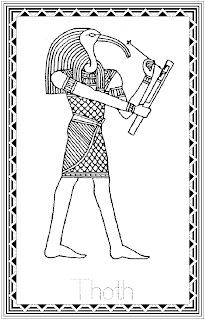
Thoth was the redeeming god because in his image the Scribe Ani chose to write about the experience of the afterworld and record it for memory that would remain: Thoth was the gift of writing to human beings to translate between the reals of the living mortals and the tenuous but vital reality of the immortals. Thoth's reed became the pouring forth of black ink that was the very line between life and death pouring from the scribe's hands.
But beyond the hands of the scribe was the woven cloth, of a far earlier memory and dream.
The Cloth was originally woven by the priestess (the Camel rests in the white rays of her moonlight). Its technology was set to break into the Pharo's selfishness. The Ibis heralds the movement away from Amon Ra the king toward first the five generations of gods, and then toward all finite mortals, mortal human beings. The pharo's corpse was wrapped in cloth, the cloth of the sutras, each was written on with a sacred prayer by the priests to guard against death and corruption.
Modern popular myth, populist myth dictates that the pharos are demonized, looked upon as decrepit mummies. However this bugaboo has lost its strength despite the film industry production of images round The Mummy (Sommers 1999 version; and its sequel "...Returns" in 2001).
Modern popular myth, populist myth dictates that the pharos are demonized, looked upon as decrepit mummies. However this bugaboo has lost its strength despite the film industry production of images round The Mummy (Sommers 1999 version; and its sequel "...Returns" in 2001).
The rich burn their wealth (The Holy Mountain, Jodorowsky, 1973), a typical metaphor (though in point of fact each avatar of the earthly divinities is wealthy to their own excess.) The point here is to move away from the pharonic accumulation of wealth. "Burn your Pharo's wealth!" The more one goulishly accumulates, the more macabre and grottesque one's final decomposition seems to be
The mummy is a monster. Mummy: mummia
Origin: 1350–1400; ME mummie
The Persian root as "mum" (meaning "wax") points to the relation between the connective gluten or glue, colle, which is found throughout the Cremaster Cycle. What sticks together and adheres.
The Persian root as "mum" (meaning "wax") points to the relation between the connective gluten or glue, colle, which is found throughout the Cremaster Cycle. What sticks together and adheres.
Egyptian religion was cold. No matter how much good work they could do the amimal faces remain immutable to any but the most primitive emotions. Animal faces lack compassion and tenderness that we humans foist as our best asset.
(The truth is we are in dire need of consultation with our animal faces-- the human face seems to have brought this planet to the verge of extinction, no matter how compassionate I might assert it to be in the ideal. The ecological face will be one that cannot simply be "many headed" Perhaps it will be the earth herself, return to the image of Gaia in infinite void of space but only as human's can render her)
The Theiromorphic Egyptian gods did not have the compassion or mutibility of a Christ born of the Jewish cloth. The face of Job was the first challenge to God to manifest the possibility of suffering before the divine hand. This face became the face of Christ, the face of a human being with a consummately bad day to deal with: crucifixion. And yet this was the threshold to the unseen and infinite God: it was the face of a human on a very bad day, a day of misery, this was the face of God. God was the punished. God was the one brought down.
And the cloth became soaked in the blood of man.
Before Christ there had been human sacrifice, pathetic and potent: sacred and abject. But always in that pattern of sacrifice the identification was with the greater personality or self who rose up from the charnal flames. Christ's figure announced that in this particular epithet all there was was the annihilation and death at the end of the road, complete torment and death one could worship as the implosion and crucifixion of Man. Grunewald's Christ...
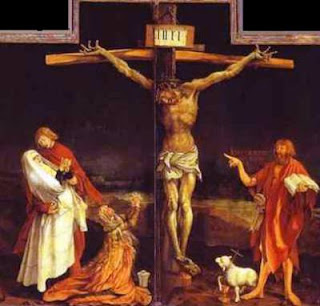
(Matthias Grünewald, c. 1515 from his Isenheim Altarpiece)
The point is for each human to become a king, and yet for Christ there was still deferral to the Father who was king. Individual sovereignty is frowned upon as egotism, and was likened again to the pride of tyrants. The pious man was humble, his pleas for help were and are incessant. The admission of powerlessness to affect situations becomes a cornerstone of prayer. But this is not merely the powerlessness reduced to infantile fantasy, this is a sacrifice of an adult, who enters a mature condition of awareness and humility before the predicaments one faces: the turmoil is endless, the possibility of falling before one's fellow men (who are also entirely sovereign) is profound. The only recourse is to prayer to request help. It is said that prayers that are requests for any kind of boon or bennison are doomed to short-sightedness in one's own way. How could someone's miniscule concern for her or himself matter in the face of the infinite universe. But the infinite divine force seems to work to deeper intimacy by tending to each infinitely small mending (Tikkun).
Christ did not step into the immanent politics of individual sovereignty. This maintained the human position as one who accedes to powerlessness and asks the universe, the Father, or the sacred for help. The father's place was that of infinite metaphor, distance from the immediacy of desire. And yet the Father had burned with desire when He spoke: fiat Lux.
It is the cloth of the Jews that held some metonymic texture of their first "homecomming" and founding of the state of Israel.
Tuesday, September 4, 2007
Metaphysical Speculations on Burning Man 2007: Ist was ich sehe und höre und rieche nicht bloß der Schein einer Welt vor der Welt?


Part 1: What is the infinite beyond toxic representation?
Black Rock City, 2007: Burning Man: sounds like a line from a poorly written detective novel: it can only be my own attempt to put this experience in phrases. Burning Man runs like a collection of cities all rolled into one for a week or two of an "art festival:" part Brigadoon, part Bankok, part Tabriz, part 1960's hippie paradise, part lethal injection. And yet the place feels safe to me; my camp-mates were largely kind, despite the brutally harsh climate of intermittent dust storms ("white outs"), toxic heat, and suprisingly pleasant evenings...
While the city takes on the shape of 40,000 or so teeming inhabitants in close woven streets the shape of concentric circles... much of the art installation is placed outside of the human habitation in a great open space of a dry lake bed, known as "The Playa." I had walked a few miles out into this open desolate space in the late morning and now simply sat down on the fine dry caked mud. I had seen a number of art pieces from various distances, including the work of Dan Das Man and Karen Cusolito, "Crude Awakening."
I was sitting out on "The Playa" ("beach!"-- there hasn't been any ocean here for millions of years) shortly before a terrible mud and sand storm will devour our encampment for 2-3 hours. There are no benches or seats out in the middle of a dry lake bed. I simply sat down. I carried a large black umbrella to shade me from the sun, but the clouds were gathering and for the moment the weather was entirely tolerable. I continued looking at the monumental piece of art in the distance "Crude Awakening"
"Crude Awakening" was a portrait of the horror of idolatry. The figures were set in praise to an oil derrick. The represent our American society which in its worst respect worships the power of crude oil, the only energy source developed and promoted. Crude oil importers and refiners become fat and rich, while "We the people" rot, waste and become impoverished by our indolence to seek any other energy resource. We are addicted to oil. I could look out of my living room window here in San Pedro and see the "minarettes" of the oil mosque: the oil refinery here in the USA.
The oil derrick was artless. Indeed, it was quite intentionally artless. There was no carving, no collage, no sign of ornament anywhere to be seen. It was a mere utilitarian structure of steel and wood. (And our society is devoted to the worship of utility at the expense of ornament.) The derrick lacked any purpose other than to gain some 40 feet of elevation above the ground level of "playa." Pure, artless elevation, it made certain people higher than others: those who rose to the top of it. I was reminded of the Zigurats of Babylon, and the ominous Tower of Babel, the root source of so much of our suffering to begin with, if we believe the myth. False escalation toward "God" or the Heavens" brings forth calamity: Tarot trump card XVI is called "The Tower." Everything in everyone's soul screamed to have it blasted.
This is also figured in Heidegger's "Frage Nach Der Technik." It was the shape of the artificial and simultaneously the artless: it was only elevation: the oil derrick itself. Artificiality that lacks art itself compared to the splendid art of the woven links of steel within the worshipping figures, some of them burned and singed by previous years of being in installation. All figures of praise... to what? To an oil derrick?
But just how much is this the true and undisputable vision of our predicament? How much was this depiction a true depiction of the times? Could we think otherwise?
Beyond the oil Derrick was the mountain. This at last was an object worth worshipping to, an object worth adoring. This I believe was Trego Mountain.
But just how much is this the true and undisputable vision of our predicament? How much was this depiction a true depiction of the times? Could we think otherwise?
Beyond the oil Derrick was the mountain. This at last was an object worth worshipping to, an object worth adoring. This I believe was Trego Mountain.
Trego Mountain through my days at "Burning Man" had an inescabable force for me: it was ostensibly a heap of blackened slag during the day, but it shone in the evening at dusk, white before a darkening sky. Mount Trego bore no signs of any plant life, simply a heap of rock, and yet it had a special trembling beauty to it.
So what was the religious question? First came the statues in expressions of worship. Rilke writes in the Duino Elegies "Praising is what matters!" ("Ruhmen, dasists!" ) Before there were statues there was just the open empty space of this Black Rock Desert and Mount Trego. Then there was an idol. The idol was clearly a bad idol. It was easy to see that it was a false divinity and to want it burned down.
So what was the religious question? First came the statues in expressions of worship. Rilke writes in the Duino Elegies "Praising is what matters!" ("Ruhmen, dasists!" ) Before there were statues there was just the open empty space of this Black Rock Desert and Mount Trego. Then there was an idol. The idol was clearly a bad idol. It was easy to see that it was a false divinity and to want it burned down.
My attentions wander further out in this great open space to the "God of Metaphor." What is this "God of Metaphor?" It is in part the essential iconoclasm that extends from Abraham and Isaac down through to Mohammed. This entire world is a metaphor for... what? (We are still waiting for the answer) We can say that the world and all its books and religions, its priest-kings (Rex/Flamen) present and represent an image of the ideal and the sacred. They manifest power of life and death, just as today the oil corporations manifest this power. But they are NOT the real power. Christ is reported to have said "My kingdom is not this kingdom" (John 18:36).
Part 2: Digression on Monotheism, Polytheism, and Pantheism
The problem I realized was the assertion of a "oneness" to this divinity. This externalized "oneness" of divinity was also the source of the externalized sense of manyness being bad. But could there be a manyness of infinity? Could there be different kinds of infinity? ... not just infinities of various finite ontic conditions (infinite apples or infinite oranges).
There is more to this argument than some sort of logical progression of ideas. I put forward polytheism as a belief system because I cannot reduce the divine or "the god of Metaphor" a single "one-ness." One-ness is a human construction. We use it to keep our very tiny minds from getting bent out of shape. I will not impose my human sense that the infinite is only one kind of infinite. If there is a space of "infinite," beyond my awe at mount Trego, for example, then that infinite leaps and over-rides itself. It is not bound to rational fixity, nor is it without the capacity to manifest as reason. It is simply beyond:the Prajnaparamita mantra: gate gate, paragate, parasamgate. Kafka calls this the sagenhafte druben, the "fabulous yonder," but I am not prepared to get into his parable on parables any more at this moment.
The father archetype here is the "God of Metaphor": the "transcendent sky god" as Lionel Corbett puts it... transcending the one and transcending the many at the same time. Were I to discuss the pantheistic perspective then I must see the divine in every moment, the mother as "god immanent" (as Douglas Overton Blue, Swami Atmatatwananda explained one lovely day about 10 years ago at the Vedanta Society in Hollywood).
I add this digression about polytheism and pantheism because I have felt oppressed by the promulgation of traditional Christian and Muslim "one-ness" of God or divinity. Something about this "one-ness" if not questioned becomes another form of idolatry... it stands between us and the divine yet again (yet another oil derrick) when the divine is best met with total incomprehension, and the best humility we can muster. The saint is sacred fool, steps once again into his innocence, the sage steps only to his defense as needed.
Part 3: Figments toward "The God of Metaphor"
IN the film Il Postino (Radford, 1994) there is an assertion about the nature of this world as a metaphor for... ( ... ).
"for example,
I don't know if you follow me...
that the whole world...
the whole world,
with the sea, the sky...
with the rain, the cIouds--
Now you can say etc., etc.
Etc., etc.
The whole world is
the metaphor for something else?"
"for example,
I don't know if you follow me...
that the whole world...
the whole world,
with the sea, the sky...
with the rain, the cIouds--
Now you can say etc., etc.
Etc., etc.
The whole world is
the metaphor for something else?"
( http://www.script-o-rama.com/movie_scripts/i/il-postino-script-transcript-postman.html )
Perhaps this is where we derrive all our nonsense about what Nietzshe dismissed as "the afterworldly": heaven. For Nietzche (Geneology of Morals), life is to be lived here in the midst of its wealth and abundance, not leached away by the vampires of the priest-hood, always promising a better place (figured also in Dostoevsky's "Grand Inquisitor.". Perhaps in this passage of simple words ["Then this world is a metaphor for... ( ... )"] we see a doorway to a much more complex expression of the world... would this then be "heaven?"
Perhaps this is where we derrive all our nonsense about what Nietzshe dismissed as "the afterworldly": heaven. For Nietzche (Geneology of Morals), life is to be lived here in the midst of its wealth and abundance, not leached away by the vampires of the priest-hood, always promising a better place (figured also in Dostoevsky's "Grand Inquisitor.". Perhaps in this passage of simple words ["Then this world is a metaphor for... ( ... )"] we see a doorway to a much more complex expression of the world... would this then be "heaven?"
Perhaps the mistake is made in the announcement of the "whole world" as a totality of "etceteras." The whole world can never be gathered, much less one single mountain, much less, in Kafka's words a trip to "The next village."
If nothing can be gathered, then nothing can be metaphored. (notice how the dialectic of nothing and no-thing-ness is constellated in this phrase: this compiles a second threshold in the text, between this world and the realm of stars.) (That previous comment is extremely problematic and must be held forth with... it marks my ineffectiveness and ineptitude in the realm of thinkers, but it may also mean I have found something.
Peter Handke writes in "Lied vom Kindsein" used in Wender's Wings of Desire):
Als das Kind Kind war,war es die Zeit der folgenden Fragen:Warum bin ich ich und warum nicht du?Warum bin ich hier und warum nicht dort?Wann begann die Zeit und wo endet der Raum?Ist das Leben unter der Sonne nicht bloß ein Traum?Ist was ich sehe und höre und riechenicht bloß der Schein einer Welt vor der Welt?Gibt es tatsächlich das Böse und Leute,die wirklich die Bösen sind?Wie kann es sein, daß ich, der ich bin,bevor ich wurde, nicht war,und daß einmal ich, der ich bin,nicht mehr der ich bin, sein werde?
The "World as Will and Metaphor" might be another term for Schopenhauer's work. In this sense "Vorstellung" becomes "Gleichnis": representation becomes parable. The parable or metaphor has the uncanny ability to somehow delay or defer desire in a sudden confusion, was this real fulfillment, or just the promise thereto? (A parallel exists here between Shopenhauer and Freud's model of incest taboo as deferral of desire... as read through Derrida's Post Card)
Part 4: The Performance: Abortion: Heinous trampling of tenderness
All these efforts to speculate on religion and the infinite should now be bracketed in the light of the "performance." This "performance" was on the night of the first into the morning of the second of September 2007. In the "performance" there was no room for the niceties of theological speculation. I am sure that given the mood of the evening anyone would simply look at me with empty eyes and tell me to stop babbling. The "Crude Awakening" stayed true to its name in this respect, and remained only alive in internal speculation. The outward expression was ghastly. To my knowledge no one was hurt or killed by the performance on the "playa." Nevertheless the maiming and killing goes on without cease in Iraq and the centers of our "crude oil" based theocracy and culture. Areas of "vital importance" to the United States are still maintained at the cost of hundreds of thousands of human lives and unknowable ecological damage.
When I look into Das Man's effort I see that the Crowd of onlookers was part of the performance. Heidegger ironically calls the everyday ignorance of humanity das mann. This ignorance was far more horrifying than the didactic spectacle of "star-spangled-salute-turned-apocalypse." We were listening to the senseless ramblings of the pathetic instrumentalizations of "The Mutator," a band started by a child molester, the audience was drawn and numbed by a special spectacle of a half-naked woman on a high wire spinning fire: the music (self-laceration) signifies something more horrible because it drew us to this location: ART AS ABORTION (the very essence of the spectacle part of Burning Man).
In the end our little spectacle was over soon enough, after two hours of numbness and waiting accompanied by the senseless cliche's of rock culture, the pablum of music called "the Mutator." Suddenly the diarhea of music was replaced by a deafening wail of a "victory siren": an unbelievably loud "air raid warning." This was followed by smoke, pathetically celebratory fireworks display, and rending apocalyptic explosion. The "derrick" was immolated in hydrogen flame, collapsed to a flaming heap, a rubble of missed expectation: the members of the audience still commented: "that explosion wasn't nearly loud enough!" or "That tower's height was still unsuitable; it should have been even more massive!" These comments, true enough point to our essential role as audience: we must remain essentially ignorant. The statues returned, through the writhing holocaust of technological pain, to worshipping the infinite: the object-lesson's criterion had been satisfied. Certainly we as a collective were least likely to consider the work's true implication. I was left to ponder the work of Carl Jung, wherein he calls the Rebis of the Rosarium Philosophorum as the object of alchemical work: "A monster and an abortion."
Thursday, August 16, 2007
More Stories and texts for Nothing and No-one

(Edvard Munch's "Madonna" ... )
A new post. A post in time, stands up the flow of language. Who do I write to? There is only writing to no-one now. Niemand's Rose: Rose de Person. What speaks the writing of Paul Celan?
"Only one thing remained reachable, close and secure amid all losses: language. Yes, language. In spite of everything, it remained secure against loss. But it had to go through its own lack of answers, through terrifying silence, through the thousand darknesses of murderous speech. It went through. It gave me no words for what was happening, but went through it. Went through and could resurface, 'enriched' by it all." (Wikipedia on Paul Celan: http://en.wikipedia.org/wiki/Paul_Celan)
Celan writes after Auschwitz, after the unspeakable. Against Adorno saying there is no poetry after auschwitz ("we must").
But what is this real language that remains secure against loss? Surely it is not simply a system of signification--- not merely the signification and transfer of one meaning to another, from literal to metaphor and back again.
Surely what remains is something more solid and transcendental: for instance the gratitude we feel at living bare life, at being at all. "In gratitude we receive.... everything... including death." Or maybe like "love," now there love is a fine Christian thing, only please through some obfuscation not call this love pure love, call it "charity," "giving to the poor"-- is this not the meaning of "charity?" (I Corinthians: 13). Love was never satisfied at merely being charity: it is the example of Job at the beginning of his trial where he gave only out of charity, and pity and every other condescending and entitled gesture one could think of. Job LOVES at the end of his travail. He loves with the whole deformity of his abject body.... whether the lover in caustic erection thrown himself into the world... or through the open sores on Job's body, Job nears the grace of G-d through the ecstasy of his body.
It is not clear who I write to. I write to the amorphous absence of the future, which varies from the crumble and decay of the past. I do not write for the past but for the absence and vacuum of the future
"Nature abhors a vacuum."
And so we try to bring all of it to fill up our boredom, to avoid the sameness of our utterly prosaic lives: for the Das Man: itself becomes a vacuum of meaning. This much Heidegger did not consider: for the nature of being for him was to fall into forgetfulness:
Seinsvergessenheit.
This was the same as the Greek: Nature loves to hide. The corrolary of the two phrases: Nature abhors the vacuum because nature is a vacuum.
The Taoist sages wrote it this way: the way that can be spoken of is not the true way.
[What then of Celan's phrase when he speaks of the "remaining" or (derridean "reste") "remainders" of language?]
[Maybe Celan was just an idealist, a structuralist who posited and believed in the impersonal absolutivity of language-- a transcendental eidetic form (Husserl's Origins of Geometry), this posited that the law itself and at least the Jews as the people of the law had the law, which was irreducible goodness in the face of such annihilation: "ah but what dreams we had!"
The law obfuscates Being, but the people of the law committed the law and therefore their language to their hearts (Kaballa)
But in doing this hiding in the ordinary and the everyday
.... I write because though there is no one to write to there is still beauty in my heart and that that beauty must be written, in some way exclaimed:
"What I do is me for this I came!"
"Fair enough" she says, though she has always been somewhat of a judge, "though the line from 'Kingfishers catch fire' is a little overdone."
It is not for her, this ideal of beauty that "I must write" because there is nothing else and it is to no one else. A broad engorged elaboration of eros across the page. Eros without recipient? Eros without receipt? Receipts are for the dead. They belong to the land of the dead, of writs and accounts. To write in this manner, at least pre-figured in this "now" (which when read becomes an eternal "then" held in the decaying fullness of the past, full even because of the very decay or patina through which it is writ) is to write as an act of desire alone into void or abyss, and thereby designating and offering it to curious inspection. To write to the abyss is not the abyss itself, but the abyss is foreshadowed in the presence of writing, after all true unselfconscious emptiness escapes the hermeneutic touch of form.
Wherever Hermes goes there he exists. One may suggest that the task then is to get Hermes to shut down: thereby in emptiness meditation to quell the god of interpretation, negativity (in the Hegelian sense of "the negative" as the restlessness of the negative).
There are philosphers who rightly speak: "whereof one cannot speak one should remain silent" (Wittgenstein). Or maybe there is Bertrand Russell's "why I am an athiest." But they all seem "a peevish bunch, these athiests, with pinched noses" (the previous phrase makes sense when spoken with the accent of a "decaying Brit" as my friend calls me: such a form of understatement is our primary weapon against the intolerable bullshit of it all): from my personal experience of the disciple of Ashley Montagu the Anthropologist, Rod Gorney the psychiatrist.
I always thought of religion to be as Edvard Munch's "Madonna," This points to the promiscuous and degenerate part of my anima (Entartete) after all it is much more clean and definitely superior to remain a clinician wearing a white smock, denying the messyness of God to explain the messyness of life. Life for the athiest is still exceedingly messy, I will give them that much. But they seem to be more like the men with mops coming in and really giving things a good clean: "remove that false belief or inflated expectation! It was probably caused by childhood abuse!" "Well," she seems to say, "fuck that!" this portrait of Edvard Munch's "Madonna," acknowledges that life is messier because it is confused: nature loves to hide.
It is said that the anima is superior to all these men "struggling with their shadows" (another phrase threatening to fall into cliche), trying to get everything clean and transparent. Men with microscopes try to split the world apart with laser like analysis. Men with microphones try to record them, to get it all down with the highest fidelity. Whereas nature merely stands up and shrugs her shoulders: she will have another gig where she will try to complete the assignation of her beauty to the moment of her dance or song.
I could of course simply be another man beating upon his drum, calling it louder and far more superior than any of the others. Again, she says "what nonsense." The anima calls us to sit down to the feast and eat together, "In the presence of mine enemies;" David got that right.
But I have said I do not write but for this ideal, or belief that there is beauty in my soul that seeks merely to spill out into form.
The sages speak as the sages always speak: that the act of writing is a covenant, and it presupposes from the first the one who was written. Without this "writing to" there can be no real writing. But could I write for no one? Could I write because there is no one I could write to... and still there was the need to speak?
Still there is the need to speak. It is the same as "still there is the need to listen," but I leave that up to you! Even though this text was written for no one (analyze Samuel Becket's "Stories and Texts for nothing," still there may be the need to read it. And I intend to write it for no one because I do not have it in my heart to designate who or what my reader should be. This then is the flower or the text offered for nothing.
Such intention is not without the possibility that it is doomed to failure, yet it breathes brief life in the interum, "for the time being" as my friend is off to say (come to think of it this is also a phrase of Dogen:
An ancient buddha said:
For the time being stand on top of the highest peak.
For the time being proceed along the bottom of the deepest ocean.
For the time being three heads and eight arms.
For the time being an eight- or sixteen-foot body.
For the time being a staff or whisk.
For the time being a pillar or lantern.
For the time being the sons of Zhang and Li.
For the time being the earth and sky.
"For the time being" here means time itself is being, and all being istime. A golden sixteen-foot body is time; because it is time, there is theradiant illumination of time. Study it as the twelve hours of the present."Three heads and eight arms" is time; because it is time, it is not separatefrom the twelve hours of the present.
http://www.thezensite.com/ZenTeachings/Dogen_Teachings/Uji_Welch.htm
I am not prepared to go into Zen this evening, let this then be my za-zen, this:
I am not prepared
Clay feet on side of mountain
The fool is awake!
We have Zen (a thousand times better that one is unprepared!) which gets into the hands of useless woodcutters and athiests:
Being prepared for it is like writing a thousand good words on any decent topic: they are fine, but can they replace the taste of milk?
Knowing the taste of milk is knowing the taste of the food one needs to survive. When mother and milk are gone, one needs to re-negotiate. Even in the absence of all the tasty milk in the universe, one still has gratitude that "once indeed I remember there was milk." -even though one should not be too sentimental. The universe forces us from every act of entitlement: the taste of milk is not yours just yet! ... And then we may be writing for nothing. Perhaps in this writing one becomes the milk in a certain sense. One hastens to think that we should not poison our mother's milk, nor should be drink too much of it, lest we become timid "momma's boys" after the age of thirty.
Ok, back to woodcutters and athiests: Once again the clean-up crew arrives with its white garments and they come and clean and scrub and provide their disinfectant sprays to the whole area: "Hygea," they cry, "let us rid ourselves of all this unsightly anima attachment, all this messyness! Let us rid ourselves of this humbuggery you call 'alchemy' or 'mystical thought!'" All these clean-up crews may have come for various reasons. They always come. They keep coming. Generally one winds up in trouble with the Anima... maybe down some black hole of addiction and suicidal paranoia: then the clinicians come in to wrap things up. But if one doesn't get into trouble. The problem is that the clean up crew is always prepared and on call, and therefore always already a million miles away from the soul, writing some stupid report for a psychiatric clinic.
There was a time when only wise books were read
helping us to bear our pain and misery.
This, after all, is not quite the same
as leafing through a thousand works fresh from psychiatric clinics.
(Czeslaw Milosz: "Ars Poetica")
How does one avoid getting into trouble? Maybe trouble is the price agreed upon when you begin to play (Edmond Jabes writes "defeat is the price agreed upon," in his "Book of Questions." Bob Dylan iterates "There aint no limit to the ammount of trouble women bring." And I say this only to get one thing clear: I am trying to get as far as possible from the anima as the "Ewig Weibliche," which Goethe idealized as some kind of salvation or cure. And it is not because I hate women (not at least consciously at this moment), but rather because I love women (Oh my God, what a completely stupid thing to say if you are an intellectual!) and want to get close to them (this is pathetic!), and gladly work to laugh at my own ideal.
Laughing anyway (somewhat pathetic)
Writing anyway (more assuredly pathetic)
More proof that I have no qualms about being totally pathetic:
Dare I write "loving?" or does this risk just too much anima attachment? Sacrifice of the ideal is the means to obtain the immortal soul, and I am thinking of Jung's pages on "Sacrifice" in "Symbols of Transformation." Nominally such a text does not appear to be too clinical. It is messy. Life is messy. Love life anyway. But the "anyway" is the strongest part of the last sentence.
The story is the same the world over for human beings (in this case "men"): you take on your anima, and it is simply too exhaustive to project on your spouse/ mate/ domestic partner/ whatever. This runs the risk of being a cliche, but I would not be afraid of my own banal, prosaic cliche-dom. I must remember the comment Thomas Mann makes of Hans Castorp in "The Magic Mountain": a paraphrase to be certain: "He would have not stayed up here a moment longer than his two week visit were it not for the lack of meaning in Castorp's utterly prosaic young man life." We go places and get waylaid because it is our meaning to do so. My meaningless cliche, like Castorp's gets waylaid because it still seeks for some sort of meaning. It is true--it is the vacuum of prosaic life, the vacuum of meaninglessness.... and nature avaoids a vacuum... by filling it, obliterating it as much as possible. I wouldn't say that because there is extra erotic energy left that I am just writing with my "big" (forgive any misrepresentations here) erection with no place to put it, but what if I am? Doesn't art come from our moments of respite from the literal world around us?
Conversely we may point to two laws of physics: that of the equal distribution of energy, the attempt of all energetic regions to reach homeostasis.... and that of the force of gravity, which attracts and pulls these objects back in. To abhor a vacuum would be akin to solution or sublimation: one goes to a higher place where the blank is in balance with presence. Conversely the principal of gravity attracts all things - from infinite distance (!) toward itself. If it is irrefutable that gravity will contract all things... then will the entire sum of the universe be (0)-Zero? (Written between Alestair Crowley's theory of Ain Soph Aur and Deleuze and Guattari's "body without organs" "the sum of whose intensity = zero... and the Chaos myth of Hun-Tun: who's body had no orifice.)
Chaos is Hun Tun, Emperor of the Center. One day the South Sea, Emperor Shu, & the North Sea, Emperor Hu (shu hu = lightning) paid a visit to Hun Tun, who always treated them well. Wishing to repay his kindness they said, "All beings have seven orifices for seeing, hearing, eating, shitting, etc.--but poor old Hun Tun has none! Let's drill some into him!" So they did--one orifice a day--till on the seventh day, Chaos died. (Hakim Bey paraphrasing Chuang Tzu, I believe) http://isp2.projects.v2.nl/freezone/ZoneText/Diversions/Broadsheets/ChaosMythsBS.html
We can try to act as a "clean up crew," but we wind up botching the whole body-without organs thing. We can clean up the text to make it make sense: a kind of Habermasian effort, or worse, we can become some some sort of Rawls or Davidsonian desperately trying to make sense. But we make sense only at the expense of our marvelous and somewhat savage wisdom: as Blake writes "The tigers of wrath are wiser than the horses of instruction."
My only advice is: Never mind your instruction! Come unprepared!
Monday, July 16, 2007
Logos, Pharmakon, Memory

Disclaimer: I do not advocate for the use of pharmaceutical alteration of consciousness in the sense of being some banal literal proponent of "Drug Culture." I am saying that we as a society are addicted to the pharmacy of the word itself. The title I am using here is an amplification of Derrida's (1983) discussion of "Plato's Pharmacy" in his book Dissemination. I am contemplating the implication of saying "all is medicine." My teacher Arwind Vasavada once said to me "all is poison; it depends how you use it!" So beware! Be wary of the parts of us that are already addicted to the media spectacle and our comfortable sense of self, your comfortable "fundamentalisms" of any kind (including scientific/atheistic): you are addicts! This is not a diatribe against usage per se, but for the sudden infusion of difference, which acts both as a poison and as a pharmacy: it can create health, or yet another black hole of addiction as well. Be wary!
Memory and Medicine: The purpose of medicine is to quicken the sense.
But in the quickening rush of the senses what is immortal is most easily forgotten, we mortals forget by following the ecstasy of thought down 10-million miles into the bottom of the ocean, but there all thought is obliterated.
Ergo the tradition of the scribe: the Egyptian Book of the Dead being just one such example. The scribe runs into the realm of the dead and through the tablet, the papyrus, the hidden inscription of an amulet from the moment he was found there, he enters into the realm of the dead. What do we bring back? A song? A sculpted ideogram of some dazzling mystery to secret to breathe? Too sacred to be imagined?
Derrida (Johnson, 1981) writes at length on Thoth as the Pharmaceutician, doctor and surgeon: the active ingredient in the Osiris Mysteries of death and rebirth. Thoth is the father of all scribes, and thus father of Ani. The principle effect of Ani is rememberance, and supplement as a way of gaining a map toward the treasures of the unconscious. As Thoth sutures (and "sutras") so does the scar hold the memory of the wound in a specific and creative way. It is not a matter of simply healing things up. It is a matter of the creative scar that is left when the wounding takes place. I will quote Derrida at length:
As the God of Language and Linguistic difference Thoth can become the god of the creative word
[c.f. Derrida's note #18 attributed to S. Sauneron, p.123: "The initial god had only to speak to create; and the beings and things evoked were born through his voice." I add additionally that this begs the question of the later Christian doctrine in the gospel of John: "en arche en ho logos."]
...only by metonymic substitution, by historical displacement, and sometimes by violent subversion.
This type of substitution puts Thoth in Ra's place as the moon takes the place of the sun. The god of writing thus supplies the place of Ra, supplementing him and supplanting him in his absence and essential disappearance. Such is the origin of the moon as supplement to the sun, of night light as supplement to daylight. And writing as the supplement of speech. "One day while Ra was in the sky, he said: 'Bring me Thoth,' and Thoth was straighway brought to him. The Majesty of this god said to Thoth: 'Be in the sky in my place, while I shine over the blessed lower regions... you are in my place, my replacement, and you will be called thus: Thoth, he who replaces Ra.' Then all sorts of things sprang up thatks to the play of Ra's words. The said to Thoth: 'I will cause you to embrace (ionh) the two skies with your beauty and your rays' - and thus the moon (ioh) was born. Later, alluding to the fact that Thoth, as Ra's replacement, occupies a somewhat subordinate position: 'I will cause you to send (hob) greater ones than yourself - and thus was born the Ibis (hib), the bird of Thoth."
This process of substitution, which thus functions as a pure play of traces or supplements or, again, operates within the order of the pure signifier which no reality, no absolutely external reference, no transcendental signified, can come to limit, bound, or control; this substitution, which could be judged "mad" since it can go on infinitely in the element of the linguistic permutation of substitutes, of substitutes for substitutes; this unleashed chain is nevertheless not lacking in violence. One would not have understood anything of this "linguistic" "immanence" if one saw it as the peaceful millieu of a merely fictional war, an inoffensive word play, in contrast to the raging polemos in "reality."
[please note the importance of the "polemos," or state of war, as comparable to Deleuze and Guattari's "War Machine" that opposes the regulation of flows of desire by the "state apparatus"- polemos opposes the state... and principally through the line of pure, intensity, radical poetry, obeying a "code of conduct" or nomos without being safely inscribed within the logos. Derrida here is taking the logos in an entirely different, radicalized direction...]
Derrida continues:
It is not in any reality foreign to the "play of words" that Thoth also frequently participates in plots, perfidious intrigues, conspiracies to usurp the throne. He helps the sons do away with the father, the brothers do away with the brother who has become king. Nout, cursed by Ra, no longer disposed of a single date, a single day of the calendar on which she could give birth. Ra had blocked from her all time, all the days and periods there were for bringing a child into the world. Thoth, who also had the power of calculation over the institution of the calendar and the march of time, added five epagomenic days. This supplementary time enabled Nout to produce five children: Haroeris, Seth, Isis, Nephtys and Osiris, who would later become king in the place of his father Geb. During the reign of Osiris (the sun-king), Thoth, who was also his brother, "initiated men into arts and letters," and "created heiroglyphic writing to enable them to fix their thoughts."
[Note here that the issue of "fixing" relates to the question of Memory, which is more of a Heideggerian question: Memory is akin to the muses Mnemosune and to the issue of truth as a-letheia, not forgetting of the ab-grund, the "abyss" or as derrida might add, its furtive supplement.]
But later, he participates in the plot led by Seth, Osiris' jealous brother. The famous legend of the death of Osiris is well known: tricked to being shut up into a trunk the size of his body, he is dismembered, and his fourteen parts are scattered to the winds. After many complications, he is found and reassembled by his wife Isis, all except for the phallus, which has been swallowed by the Oxyrhynchus fish. This does not prevent Thoth from acting with the cleverest and most oblivious opportunism. Isis, transformed into a vulture, lies on the corpse of Osiris. In that position she engenders Horus, "the-child-with-the-finger-in-his-mouth," who will attack his father's murderer. The latter, Seth, tears out Horus' eye while Horus rips off Seth's testicles. When Horus gets his eye back, he offers it to his father - and this eye is also the moon: Thoth if you will - and the eye brings Osiris back to life and potency.
[At this point the most potent question to be asked for me remains focused on the issue of whether we as humans have any part to play in the immortal agitations of the "gods." Their struggle is immortal. However we, like the scribe Ani are definitely mortal. Nevertheless there is an aspect which compells me to continue to search for some manner in which the soul will set forth in its small canoe into the universe, the vision of moving into the ocean of heaven of lights and all the stars... to behold the starry firmament and remain in wonder... is this the one moment we have at eternity? -Not to speak of the gnawing need in each mortal being to somehow attain some soul level of immortality, through dreams, through research and analysis (what Edward Edinger called the last inflation of the soul, and possibly that which creeps into analysis itself, the denial of one's, "ownmost" and very personal mortality)] Derrida goes on to write on the methods of the physician to the gods, perhaps alluding to the process of doctoring of mortal men as well:
In the course of the fight, Thoth separates the combatants and, in the role of god-doctor-pharmacist-magician, sews up [suture...sutra] their wounds and heals them of their mutillation. Later, when the eye and the testicles are back in place, a trial is held during which Thoth turns on Seth whose accomplice he had nevertheless once been, and confirms as true the words of Osiris. (pp. 89-90)
"Words have got me the wound, and will get me well, if you believe it." (Jim Morrison, who probably slipped into the quiet, overly soft yoni of a heroin overdose: opium for Orpheus endlessly gone in search of Eurydice in the realm of the dead: Haides).
But memory is forgotten. when we step into the realm of the dead, which is also the realm of immortal images whe must step into the river lethe. The river of forgetfulness is also the river of flux--- hule, eternal turning, seething transformation which forgets itself.
But the Medicament of words creates, saves or salts in memory
William S. Burroughs seems to believe that writing itself is an intoxicant and a drug. And there is a portion of writing that is nothing more than a text-- a textile or a covering--- a simulation or a dissimulation--- a pretending of what is there that is not covered in the apocalypse. Writing is a form of illusion--- supplement and deferral.
Derrida, writing of Plato writes of the connection of Logos and Pharmakon.
But this writing itself seems aenemic, somehow as pallid as the empty page. Perhaps I am unfair to Derrida right now, after all I owe him so much.
Is language the fundamental forgetting of what was said?
"'What is your truth?
"'-What lacerates me.
"'And your salvation?
"'-Forgetting what I have said."
(Edmond Jabes, "The Book of Questions")
Here oblivion seems like a form of mercy.
Jean Luc Nancy utters his battle cry in "Hegel: The Restlessness of the Negative": that (as a paraphrase) "what we search for, what we need the most, is Truth not consolation." and Dunya Mikhail writes/speaks on NPR:
For Mikhail, writing about war is not necessarily a way to heal wounds, she says.
"On the contrary, it keeps [them] open forever," Mikhail adds. "Poems are like X-rays. It makes you see the wound and understand it."
(http://www.npr.org/templates/story/story.php?storyId=11762755 )
The wound then occupies a double exposure-- it rests in the shadow of the medicament. Every medicament was fostered by the originary wakefulness or stumbling block or a wound or rupture. Waking up is fine, but we struggle through the wound that also draws us back into the unconscious, a syphon or an abyss retracting infinitely into some black ground that is unknowable.
A friend of mine is participating in the step program of AA-- A Fearless Moral Inventory..... a relentless self-inventory. An exhaustive self-inventory. And I keep thinking about the capacity of words to intoxicate: This is a problem. My friend is a poet. In writing his inventory he must avoid becoming intoxicated with language or the relentless spiral of his own self-laceration. What he reminds me to do is somehow remember some part of myself through the contorted shape of his own sobriety... something about protection of what is vulnerable in him and by extension in each of us. We keep speaking about the literal and metaphor. In our discussion metaphor is a savior, because we see our sociopathic tendencies laid out before us: his is to drink, mine is to participate in my own unspeakable nature. So far I have been able to avoid literalizing my own horror, but he is in a program because he has admitted his powerlessness over his urge to drink. Finally enough drinking tends to localize the psychopathic into a self-destructive cycle: well rather than abusing others he simply just drank.... He is on his way to becoming something vulnerable-- perhaps that is our goal in this life... to obtain the greatest vulnerability
Enough!
These few words are enough!
If not these words then this breath...
If not this breath then this opening
To the life we have refused again and again
Until now-
Until now.
(David Whyte)
And if we open to life we will become vulnerable. At this point the vulnerability of letting go of words to life is another moment... but what is life but the green gathering of life in the sun? Is there a hidden serpent of sentimentalism in this leave-taking of words, to say they were "enough!" There are times when one has to say that what is said is enough... but in this the case is not closed--- the stress is on the opening to the buzzing blooming life that has always existed, that is in a sense mute... to be protected as the one who does not speak to prosecute or defend--- as soul itself--- the vulnerability of "opening to the life we have refused again and again... until now, until now."
James Hillman wrote in his introduction to "Suicide and the Soul" that suicide is the ****literalization of the death instinct, and goes on to suggest that literalism is suicidal, perhaps even that literalism is suicide (but only if taken literally).
And then comes this restless mastication of poetry, something to draw one back in from the toil of recovery.... "some human beings are recovering from alcoholism while still others are becomming addicted to their alcoholism" (a paraphrase of a news release I have written about previously, wherein a newscaster
"Words to hypnotize
Words to mezmerize
Words to make my mouth exercise
Words all fail the magic prize
Nothing I can say when I'm in your thighs."
(Violent Femmes)
In this sense words fail miserably to produce anything other than self deception. But the Violent Femmes are really nigredo poets: their reality sears and corrodes (the melting away of apparent surfaces) born from some sewage in Milwaukee it is the best of American Pop that European Aesthete consciousness can neither entirely encompass nor can it ignore them. They revel in the scum at the bottom of the barrel. But bless them, I don't think that they are poets of health! I do not think there was ever dawn in the summertime that spoke to them. Their music is all ground up cigarette butts and spilled beer. But the value of this is their grounding horror.
There is a whole slew of Wittgensteinian epodes that ensue: "whereof one cannot speak one should remain silent."
wherein we come to our internet discomfort of: what is all this babble that ensues in countless and seemingly meaningless web-logs that signify only what they mean to signify.
To remain like water in water without the turning. Followed by the turning, which is the techne-- or technology of the text itself--- beyond the meaningless one-ness of homogeneity technology invents a play and a wound.
When exposed to the pharmakon I am exposed to the intensification of images (as metaphor allows). But I forget, and thus ask the page itself to remember. The page remembers even as it uncontrolably disseminates, proliferates meaning. Later I (which "I?") return to the page and transform it further... and it transforms me: or it further transforms that locus of experience I attributed as temporarily "myself" or "me" that was changing anyway.... As an externalized text it becomes once again other, something else, other than the force one originally took in placing fingers to keyboard or pen to page.
According to David Ulansey: initiation comes when the wound is somehow left open--- the circumcision remains open keeping one initiated into the fundamental suffering of the wound. The wound is horrible, kept in the source of the genitals--- in the root of pleasure is a literal interdict of civilization: here too is suffering.
To be initiated is to experience the fundamental flux of the universe: what was a child is killed and in its place is an adult man, and so on. The shaman takes the experience of initiation to its furthest reaches.
By this for the shaman the wound is deepest, and the essential hermaphroditism of the wound is in the process of being expressed or accomplished. Primitive initiantion systems work with wounds, laceration, circumcision and scarring as intentional wound. This is still a fetish approach in terms of "deviant" western sexuality that seeks to eroticize piercing or scarification
Medicine acts in two manners: (1) it "heals" wounds that are too terrible for life to endure or (2) it wakes us up to the possibility of our life: it is an intentional wounding or ripping open of the veil of sleep (if the doors of perception were cleansed... writes Blake).
I am one for lengthy analysis. I do not believe that when we attend to the process of therapizing that we should rip open any veils. It denies the dance of veils. And the civilized human being allows the careful dance of the Anima without abusive disection of the movement, down to the formaldehyde cadaver... that never was the dance!
The laboratory agent feverishly works over the material or substance, attempting to expose its inner nature--- what we get in this society of chemistry is the apotheosis of quantity: the atomic bomb. If it is true that the ancient science of Alchemy resulted in a kind of labyrinthine manual of sex magic... what was written there was some endeavor or effort that amplified the intensity of experience... through magic, spell and curio, through both the most simple and heightened feats, amplified the acrobatic artistry of eros.
The ripping and rending of rupture and as wakefulness, the violence of a vow of abstinence to confront the death drive violence of living solely with any one consumptive idea provided through a powerful intoxicant that kills us... through this we drive to become one thing. Through a yoga of abstinence, holding one position, and becomming just one thing, we allow the fires to burn a little brighter from within, thus gathering intensity of experience....
It is always difficult to become this one thing--- to press one's figure into a single tortured shape-- into an ideogram of the self--- to make the body into a heiroglyph of its art--- this too is technology and this too is a nightmare in our epoch. We think we might be able to become one thing... but the world does not stop for a moment, it is too compassionate to stop for even a moment. And so through this effort to become one thing we become a mark--- a sun-spot on the surface of the sun, boiling collectivity. we remember, even if this memory is futile, even if it is washed away in the washing generativity of a solar moment.
The logos acts as a gathering, a memory, a sentimental attachment to what is to be remembered. But the logic of a text conceals (Heidegger). And text is textile, the "shroud-sail" (Dylan Thomas) of concealment, woven on the loom, the the web of a spider, or perhaps Helen's depiction of the Trojan War, the amniotic sac (and the medium of the fluid). Still we are born out of words into experience and from experience out into words (articulation) again. To become attached is to deny and reject the constant ensuing of life--- that always ensues and always is new, its blooming buzzing confusion... forgets itself endlessly, finds itself intoxicated... "though sometimes it is necessary to reteach a thing its lovliness..." (Galway Kinnell) there comes a moment when one holds to being just one thing for so long: the act of memory becomes an oppressive sclerotic hardening of the heart and of experience.... then we must re-teach it to simply live in its abundance... "enough..." the movement between the suppleness and the forgetting, the unconsciousness of the nubile, the youth, its cruel lack of sensitivity to its own forgetting, the indifference and whimsy of youth.
The old ask to be whisked away, to allow the new to bloom again in its supple youth. This final act of forgetting is called death... and ultimately it comes to the consciousness that witnessed so many springs, summers, autumns and winters, after so long this consciousness too descends... and it was never too long, shorter than expected, just a slip, when so many moments we have been simply wasted...
Thursday, July 5, 2007
Talkin' Independence Day 2007 USA Blues Part 1

The United States of Black. - Red and White bars are all over town - host the immediacy of this American Empire. These Red and White, uneven rambling root- bars that writhe in the dust. There is no easy paralell - this ain't no Nike ad, the track ain't even, it's twisted in the rubble and the wreckage of a century and a half of greed in this nation. No thin white lines, sleek and emaciated lines of Liberty for the shining runner lady to run between. No certain red - no way, no folks neither. Rather the red like the brown-red man - Chicano laborer - brown pride, black pride... and as for white pride? Well, I have none! There is no white pride that isn't some epithet for the Ku Klux Clan. Brown pride and black pride, I hope you will do better! Well at least you can fight while the shadow of white pride creeps up like a vine that's strangling you. White pride has become a corporate cancer. This color line is still the power line is still the poverty line. This line, this power to life, held in the hands of wicked men, this power over life can never BE life... that's what one man has said, and I believe him. I've got no voice on this flag of pride. I've got no "Blue Angels" - I've got no bright stars and broad stripes! Singing: "Off we go into the wild blue yonder..." I dont have time for that! That kind of jingoism is the worst insult: "we go off into the wild blue yonder, leaving you behind!" What Independence is there on Independence day 2007? What independence is there when we have got troops over in Iraq, waiting to die defending the democracy that they really believe in, waiting to die defending my freedom of speech? Let me ask you this. Let me put you to this question: Are you willing to die defending the democracy that someone else told you to defend because you wanted to hold a legal gun in your hands? Did you ever think that the war was lost back at home? When the Robber Barons told you to die defending their democracy did you ever think of that? Did you ever decide to die defending their right to free speech? Maybe you wanted to die defending the American Empire? Did you ever think about that? Democracy or the American Empire, whichever comes first, give or take! ...When we have culled all the black nations for their terrorists--- terrorists, they hide in the mobs of the innocent and explode themselves, shoot marines with guns. And let's be frank, no matter how much some of these boys wanted to hold a gun in their hands, I don't think many of them want to shoot a nursing mother through the head. I don't think these marine boys want to use their grandmothers as decoys or as faulty body armor - now that is obscene! Brown pride - White pride - Gay pride - This country is no poem - Poems now are words that act as lies in the hearts of men - this country is no poem - written in fact by the poet, sitting in the Slum. Sitting in the slum, the poet Aj Dagga Tolar sits and writes his poem. He is sitting in Nigeria, in Lagos, in the slum of about 5-million, Ajungele, the jungle. He writes that this country is not a poem. Well, now, everywhere is a slum, not as desperate as Lagos, but everywhere is a slum: we are all slumming for the American "Standard of Living" - a living of life that has gone too far, that bought too many races, that kept its passions beating too strongly for the American whore. We might all go back to life, back on the farm, but we cannot resist the city, even the artists and the bohemian sculptors, forgive us a little for being seduced, we believed even just a little that she had some kindness. We cannot resist the city with its famous Americans: William Burroughs, Charles Bukowski - drunkards, lusches and letches, junkies, tricks with whores. America is not chaste and its heroes are neither. But that is not the only story in town. I cannot believe that that is the only story in town. Each man searching for liberty at the bottom of some addiction. The rebels and the revolutionaries search for an addiction other than our addiction to American pride and glory, the glut of technological Rome in an American empire. That is not the only story I heard you say, I heard that one must say! Not the only story in town, it circles down to its own rock bottom, as you try to avoid fundamentalism like pigs on the wing. It circles down, you follow it round, you give it size, you give it measure, you say "It gives me life, this American land!" You said a lot of things on the way down to try to find yourself, but there was no one there when you hit the bottom, just a predicament, just an empty American high school classroom where there are no students. I mean, who is really willing to learn? Are the robbers willing to learn? All the unruly teenage players have left the classroom, and now its just one big recess. They will come in again, but I will be there waiting to tell you that this is America! How do you hope to teach the Cholo-gangsters? How many speed bumps of education do you wish to put in the way of a life that is gone too fast? How many speed bumps of metaphor do you wish to put in the way, to say Life is but a metaphor, when we know that for them metaphor just gets in the way of their struggle and their suffering will to power. Life has gone too fast in the American inner city - the young man grows up his whole life round liquor and booze - how do you hope to teach them that this is some American wasteland where their fathers and their fathers' fathers have been forgotten and fogotten again and again, that we have made at each step a deliberate attempt to forget them? We live on eating each other: cheap Hispanic labor. I know, another hornet's nest: "to live outside the law you must be honest," but America? Outside the law? Never! Was there anything in America that was outside the law? America was the land ot the law - and it always promised religious freedom. Now we have Puritanical churches, or, what's worse, Satanic Junkies - Jerry Falwell getting fat and slick on your blood. Walt Whitman wrote a poem. Walt Whitman wrote that poem for the captain of his country... a poem for his captain. And maybe there, behind suspenders and a broad rimmed hat - maybe crossing Brooklyn Ferry - maybe there at dawn - you might find the American we desperately need. But what good is the dawn of our country when each passing day we become more of an empire? What is left is each man's private home. Each man steps into his abode like a fortress. Each abode is a fortress as distant as another nation. Here we hold the flag for our nation: No longer the stars and stripes, it reads with the number of our house in black and white. I painted it there. I added a star because stars stand for other places and other predicaments, I added a fertile valley of a crescent moon, or a Saracen sword, to cut a little deeper into the valley, to cut away the American Empire, to till the land a little deeper. It says that there is no American flag flying here. There is no red, white and blue. There is clay-red, and bone white and all-devouring black - inside our living room - that is all you will ever see: just bones, marrow and emptiness. You can cut through the emptiness with your thin white lines but you won't hit anything, not even a star to split in two with your scimitar.
Subscribe to:
Posts (Atom)
